 English
 русский
 Español
1. Core Definitions: The Logical Evolution from Microscopic Fiber to Macroscopic Textile
In the global landscape of the textile industry, Cotton Core Yarn Textile represents a sophisticated engineering achievement that integrates multiple material properties into a single cohesive structure. Understanding this product requires a deconstruction of the three physical dimensions of textile production.
1.1 Fiber — The Cellular Level of Construction
Fiber is the most basic unit of any textile material, defined by a length-to-diameter ratio that allows for spinning and interlacing.
- Outer Sheath Fiber: Utilizes natural cotton fibers. This component provides the Cotton Core Yarn Textile with its essential soul—breathability, high moisture absorption, and a soft, hypoallergenic touch against the skin.
- Inner Core Fiber: Typically consists of high-tenacity synthetic filaments like Polyester or highly elastic filaments like Spandex. These remain invisible in the final Cotton Core Yarn Textile, acting as a structural skeleton that provides strength or stretch that natural cotton lacks.
1.2 Yarn — The Structural Command Center
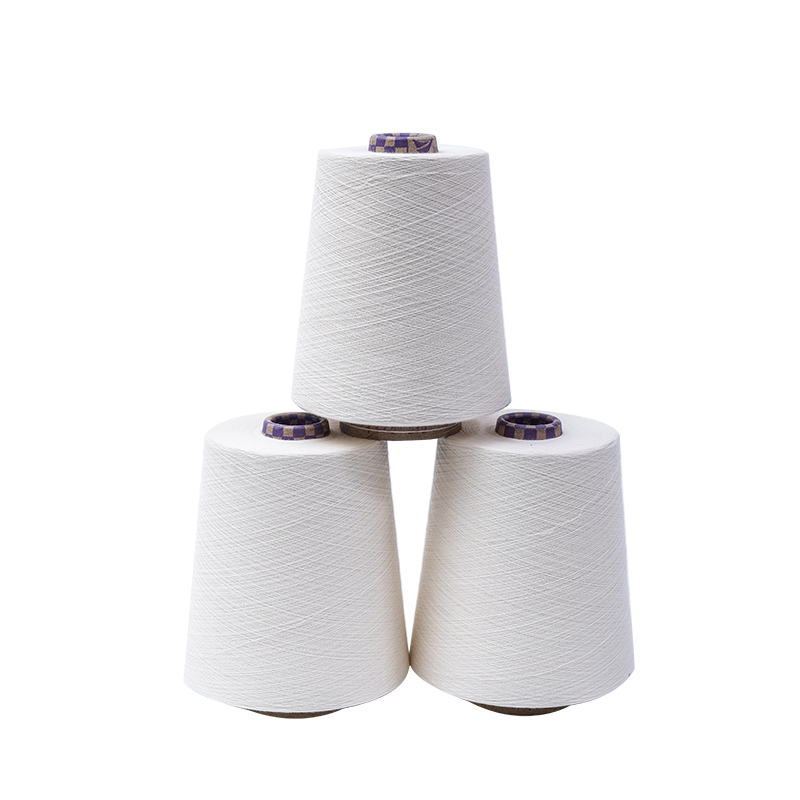
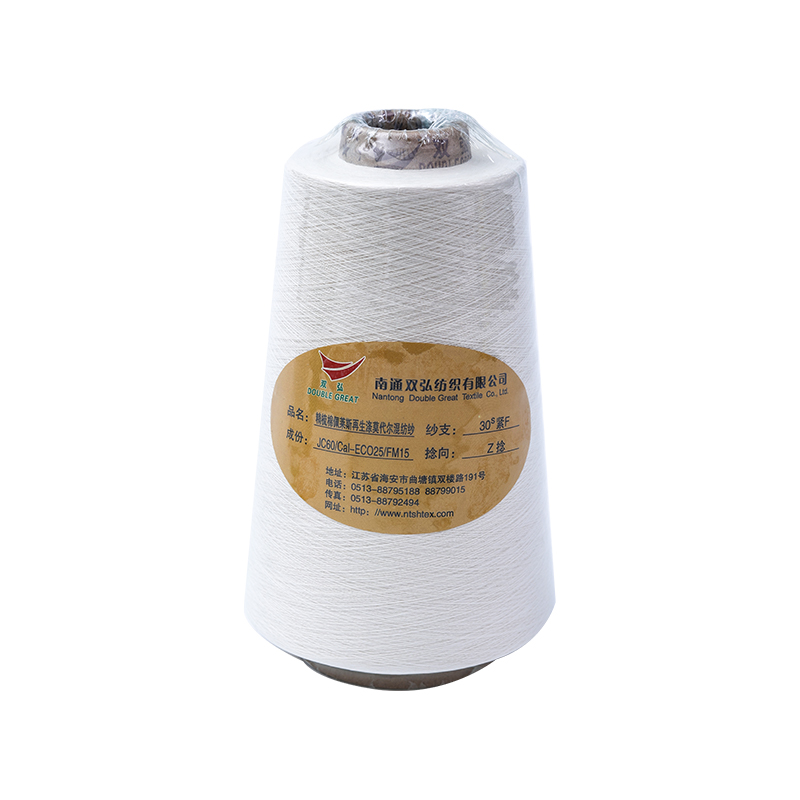
Cotton Core Yarn is the intermediate stage where fiber engineering takes place. Unlike blended yarns where fibers are mixed randomly, this yarn is a composite.
- Spatial Arrangement: During the ring-spinning process, the filament core is kept at a constant tension while the cotton fibers are twisted around it, creating a sheath-core geometry.
- The Core Advantage: This specific structure ensures that the Cotton Core Yarn possesses the mechanical properties of synthetics while maintaining the visual and tactile identity of 100% natural cotton.
1.3 Textile — The Integrated Performance Fabric
When Cotton Core Yarn is woven or knitted, it becomes a Cotton Core Yarn Textile. This final stage is an engineered surface where the internal energy of the core filaments is harnessed to provide fabric memory, preventing the sagging or bagging commonly associated with traditional 100% cotton fabrics.
2. Technical Parameter Comparison: Performance Transformation
To understand why Cotton Core Yarn Textile is superior in specific applications, we must analyze the physical parameters at each stage of production.
2.1 Fiber Phase: Material Properties
| Parameter | Natural Cotton Fiber | Spandex Core | Polyester Core |
| Breaking Tenacity (cN/dtex) | 3.5 - 4.9 | 0.5 - 1.2 | 4.5 - 7.5 |
| Elongation at Break (%) | 7 - 10 | 400 - 600 | 15 - 30 |
| Moisture Regain (%) | 8.5 | 0.8 - 1.2 | 0.4 |
| Heat Resistance | Excellent (stable to 150C) | Sensitive (degrades above 100C) | High (Melting point ~260C) |
2.2 Yarn and Textile Phase: Structural Performance
The transition from individual fibers to a Cotton Core Yarn Textile results in a significant boost in mechanical utility:
- Strength Utilization: Cotton Core Yarn typically shows a 20% to 40% increase in breaking strength compared to a pure cotton yarn of the same count.
- Elastic Recovery: While pure cotton textiles have nearly zero elastic recovery (resulting in wrinkles), a Cotton Core Yarn Textile can achieve over 90% recovery after being stretched, depending on the core-to-sheath ratio.
3. Manufacturing Process of Cotton Core Yarn Textile
Creating a high-quality Cotton Core Yarn Textile requires precise mechanical synchronization to ensure the core is never exposed.
3.1 The Spinning Phase: Precision Encasement
On the spinning frame, the filament core is fed through a tension-control device into the center of the cotton strand.
- Draft Ratio: For elastic Cotton Core Yarn, the core is pre-stretched (often 2.5 to 4.0 times its original length). When the resulting Cotton Core Yarn Textile is finished, the core contracts, giving the fabric its signature stretch.
- Twist Factor: A higher twist is often applied to ensure the cotton fibers tightly grip the smooth synthetic core, preventing slippage where the core and sheath separate.
3.2 The Weaving Phase: Tension Management
When converting Cotton Core Yarn into a Textile, the loom must be calibrated to handle the yarn's internal tension.
- Fabric Density: The density must be high enough to protect the core but open enough to allow the elastic properties to function.
- Structure Selection: Twill and satin weaves are frequently used for Cotton Core Yarn Textile to allow the yarn more room to move and stretch, which is ideal for performance denim and workwear.
4. In-Depth Performance Analysis
4.1 Overcoming Natural Limitations
Traditional cotton fabrics suffer from permanent deformation—once the knees or elbows of a garment are stretched, they do not return to their original shape. Cotton Core Yarn Textile solves this through internal reinforcement. The core acts as a spring, pulling the cotton fibers back into place after every movement.
4.2 Enhanced Durability and Longevity
In Cotton Core Yarn Textile, the core filament acts as a binder. Even if surface cotton fibers face abrasion, the structural integrity of the fabric remains intact because the high-tenacity core prevents the yarn from snapping. This significantly extends the wear-life of the textile in industrial and heavy-duty environments.
5. FAQ: Understanding Cotton Core Yarn Textile
Q: Does Cotton Core Yarn Textile feel different from 100% cotton on the skin?
A: If manufactured correctly, the skin only touches the outer cotton sheath. This means a Cotton Core Yarn Textile provides the exact same comfort and dry feel as pure cotton, with the added benefit of hidden performance.
Q: Why is Cotton Core Yarn Textile often more expensive than standard fabrics?
A: The cost is driven by the complexity of the spinning process, the requirement for specialized tension-control machinery, and the use of two different raw material streams (natural and synthetic).
Q: How does the core affect the dyeing process of the textile?
A: Since the core is buried inside the yarn, the dyeing process primarily targets the outer cotton. This ensures deep, rich colors. However, high-quality Cotton Core Yarn Textile requires high covering power to ensure the core filament does not grin through or reflect light differently than the cotton.
Q: Can this textile be recycled easily?
A: Because it is a multi-component material, recycling Cotton Core Yarn Textile requires chemical separation of the natural and synthetic parts, which is more complex than recycling single-fiber textiles.