 English
 русский
 Español
Technical Analysis of Cotton Core Yarn Textile
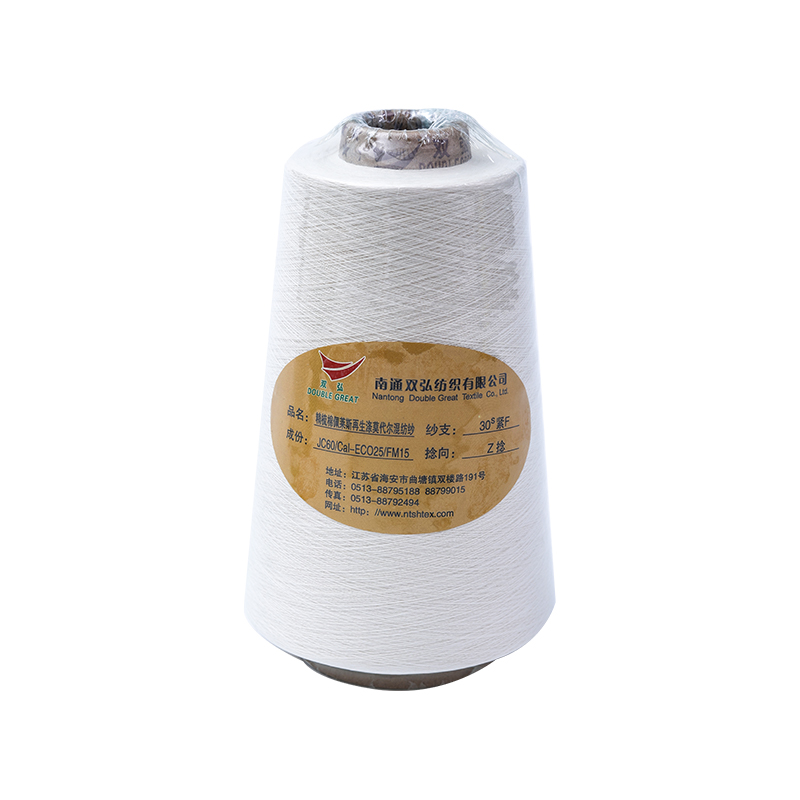
Cotton Core Yarn Textile represents a sophisticated fusion of natural aesthetics and synthetic performance. By integrating a high-performance filament at the center with a natural cotton sheath, this textile technology addresses the inherent limitations of pure cotton while maintaining its beloved tactile qualities.
Structural Composition of Cotton Core Yarn
The architecture of Cotton Core Yarn is defined by a coaxial arrangement of two distinct components. Unlike blended yarns where fibers are mixed randomly, this structure is intentional and hierarchical.
The Central Core: This is the structural heart of the yarn. It typically consists of a continuous filament. For elasticity, Spandex (Elastane) is used; for mechanical strength, high-tenacity Polyester or Nylon filaments are preferred.
The Cotton Sheath: This is the exterior layer composed of staple cotton fibers. During the spinning process, these fibers are twisted around the core filament, ensuring that only the cotton is visible on the surface and touches the skin.
This dual-layer system allows Cotton Core Yarn Textile to exhibit the "soul" of synthetic fiber and the "skin" of natural cotton.
Comparative Physical Parameters
To understand why Cotton Core Yarn Textile is superior in specific industrial applications, it is essential to analyze the technical data. The following table compares standard 100% cotton yarn with two primary types of core-spun yarns.
| Property | 100% Pure Cotton Yarn | Cotton/Spandex Core Yarn | Cotton/Polyester Core Yarn |
| Tensile Strength (cN/tex) | 15 - 20 | 20 - 25 | 35 - 55 |
| Elongation at Break (%) | 5% - 8% | 150% - 450% | 15% - 25% |
| Elastic Recovery | Very Low | Excellent | Moderate |
| Abrasion Resistance | Standard | High | Superior |
| Moisture Regain (%) | 8.5% | 7.8% - 8.2% | 6.5% - 7.5% |
| Shrinkage Rate (Washing) | 5% - 10% | 2% - 4% | Less than 1% |
Parameter Insights:
Strength Enhancement: The Polyester core provides a significant boost in tenacity, making the Cotton Core Yarn Textile ideal for high-speed industrial sewing and heavy-duty workwear.
Dimensional Stability: The synthetic core acts as a stabilizer, preventing the cotton fibers from collapsing or over-expanding, which significantly reduces the shrinkage common in natural textiles.
Production and Manufacturing Mechanics
The creation of Cotton Core Yarn Textile requires specialized modifications to traditional ring-spinning frames. The process is a balance of tension, speed, and fiber alignment.
The Feeding System: The core filament is fed through a tension-control device located behind the front rollers. In the case of elastic Cotton Core Yarn, the spandex is pre-drafted (stretched) at a ratio typically between 2.5x and 4.0x. This stored energy is what gives the final fabric its stretch.
The Covering Process: As the cotton roving is drafted into a thin ribbon of fibers, the core filament is introduced at the nip of the front roller. The twist imparted by the spindle causes the cotton fibers to wrap helically around the filament.
Critical Quality Control: The Grinning Effect: A major technical challenge in Cotton Core Yarn Textile production is preventing grinning—a defect where the core filament peeps through the cotton sheath. This is managed by optimizing the twist multiplier and ensuring the core filament is perfectly centered during the spinning triangle phase.
Functional Varieties of Cotton Core Yarn Textile
High-Stretch Denim and Activewear: By using a Spandex core, manufacturers produce Cotton Core Yarn Textile that can stretch and return to its original shape. This is the foundation of modern Power Stretch denim. It prevents the baggy knee syndrome found in 100% cotton jeans.
High-Tenacity Workwear and Uniforms: Using a Polyester filament core creates a yarn that is nearly impossible to tear manually but feels like a soft cotton shirt. This is essential for military uniforms and protective industrial clothing where durability is a safety requirement.
Thermal and Conductive Textiles: Advanced Cotton Core Yarn can feature specialty cores like stainless steel for anti-static properties or ceramic-infused filaments for heat retention, all while maintaining a 100% cotton surface for wearer comfort.
Common Questions and FAQ
Is Cotton Core Yarn Textile more expensive than 100% cotton?
Generally, yes. The cost of the synthetic filament and the specialized spinning process increases the price per kilogram. However, the increased durability and reduced fabric waste often make it more cost-effective for high-end garment production.
Does the core filament affect the dyeing process?
Yes. Cotton and synthetic cores require different dye classes. For a solid color, a double-dyeing process is used—one for the cotton (Reactive dyes) and one for the core (Disperse dyes). If only the cotton is dyed, the core remains white, which is sometimes used for aesthetic heather effects.
How do I identify Cotton Core Yarn in a finished fabric?
The most reliable method is the Untwist and Pull test. If you untwist a single yarn and find a continuous, unbroken filament inside the bundle of short cotton fibers, it is a core-spun yarn.
Does Cotton Core Yarn Textile pill easily?
Pilling resistance depends on the twist and the quality of the cotton used for the sheath. Because the core holds the fibers tightly, high-quality Cotton Core Yarn often has better pilling resistance than low-twist 100% cotton yarns.
What are the washing requirements for these textiles?
For textiles with an elastic core, avoid high-heat drying (above 60 degrees Celsius) and chlorine bleach, as both can degrade the core filament, causing the fabric to lose its shape and snap back ability.
Industrial Impact and Sustainability
The adoption of Cotton Core Yarn Textile has revolutionized the longevity of clothing. By reinforcing cotton with a resilient core, garments stay in use longer, directly contributing to a reduction in textile waste. Furthermore, this technology allows for the creation of ultra-fine fabrics that would otherwise be too fragile to weave or knit using pure cotton.
In high-density weaving, the core provides the necessary break strength to withstand the mechanical stress of modern looms, resulting in fewer defects and higher production efficiency across the textile value chain.