 English
 русский
 Español
Textile Material Focus
CORE / 01
Core-Spun Yarn Structure and Application Guide
How Does Cotton Core Yarn Affect Strength, Comfort and Fabric Performance?
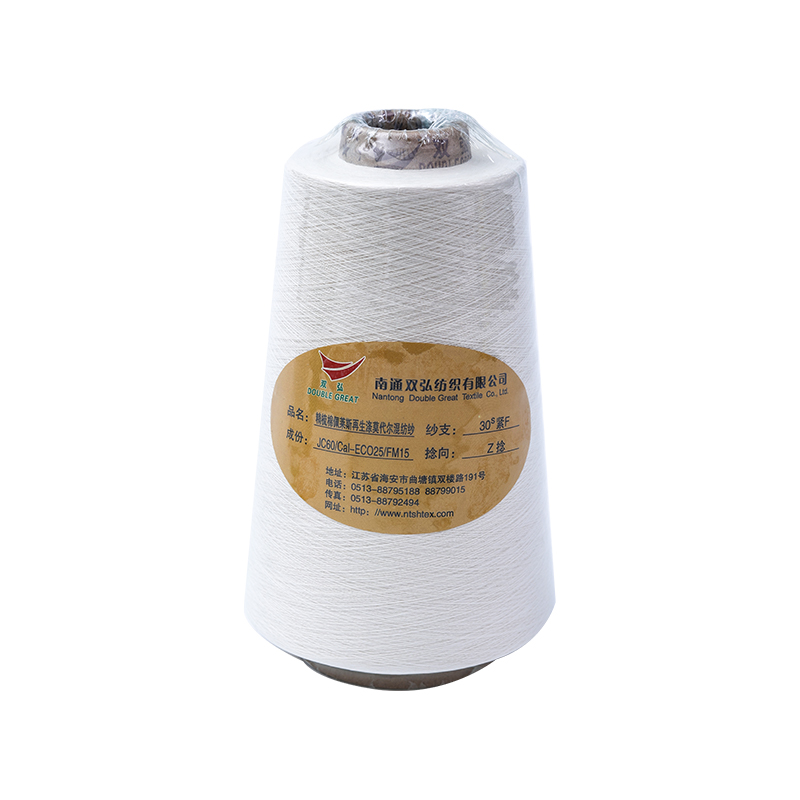
Cotton Core Yarn is not a single fixed yarn specification. It describes a yarn construction in which cotton forms the central core, the outer covering, or an important component of a layered yarn structure. Its performance depends on the location of the cotton, the material surrounding it, the core-to-sheath ratio, yarn count, twist level and intended textile application.
Cotton core constructions can be engineered for apparel fabrics, industrial canvas, upholstery, sewing thread, decorative textiles and technical woven materials. A correct specification must identify the core material and the sheath material clearly because cotton core spun yarn, polyester-core cotton yarn and nylon cotton core yarn may behave very differently during weaving, dyeing, finishing and repeated use.
Direct Technical Answer
What Is Cotton Core?
In yarn engineering, a cotton core is a central strand or bundle made primarily from cotton fibers. Other fibers may be wrapped, spun or twisted around this center to modify the yarn's strength, abrasion resistance, appearance or processing behavior.
The term may also be used informally for yarn with a cotton-rich central structure. Product specifications should always state whether cotton is located in the center or on the surface. A yarn with cotton inside and polyester outside does not provide the same touch, dyeing response or moisture behavior as a yarn with polyester inside and cotton outside.
Structure 02
How Cotton Core Spun Yarn Is Constructed
Core-spun yarn combines at least two material zones. Each zone performs a different function within the same yarn body.
Core Alignment
A centered core supports more uniform mechanical performance. An off-center core may produce uneven strength, irregular dyeing or inconsistent fabric appearance.
Sheath Coverage
Complete sheath coverage prevents the core from becoming visible on the yarn surface. Coverage depends on staple length, twist, drafting control and the core feeding position.
Core-to-Sheath Ratio
A higher core percentage usually increases the influence of the central material. A heavier sheath can improve surface softness and conceal the core more effectively.
Terminology 03
What Does “Cotton to the Core Yarn” Mean?
The phrase cotton to the core yarn may be used to describe a yarn containing cotton throughout its structure or a yarn with a clearly defined cotton center. The wording is not sufficiently precise for production purposes.
A technical specification should identify the fiber content of the central component, the outer component and the total yarn. It should also state whether the yarn is core-spun, covered, plied, blended or hollow.
A complete description should include
Comparison 04
Core-Spun, Covered, Blended and Hollow Yarn
Similar-looking yarns may have different internal structures and should not be treated as interchangeable materials.
What Is Hollow Core Cotton Yarn?
Hollow core cotton yarn is a yarn structure containing an internal cavity rather than a completely solid cross-section. The hollow area can be created by spinning cotton around a removable core, by using a special fiber arrangement or by applying a process that leaves an open internal channel.
The hollow structure may reduce yarn weight while maintaining visual bulk. It may also increase the amount of trapped air, which can support thermal insulation. The actual result depends on the size and stability of the hollow area.
More volume can be created without a proportional increase in material weight.
The yarn can produce a fuller surface in knitted or woven fabrics.
Internal air spaces may support insulation in suitable fabric constructions.
Excessive pressure or unsuitable finishing can collapse the hollow structure.
Materials 06
Common Cotton Core Yarn Material Combinations
Material selection changes yarn strength, surface character, moisture response and heat behavior.
Cotton Core with Polyester Sheath
Cotton provides internal bulk and moisture interaction. A polyester outer layer can increase abrasion resistance, reduce surface hairiness and improve dimensional stability.
Surface: smoother and less absorbent than exposed cotton
Processing: dyeing method depends on the visibility and percentage of each fiber
Use: durable decorative fabrics, selected canvas and composite textiles
Polyester Core with Cotton Sheath
This common core-spun arrangement uses polyester to increase tensile strength while cotton forms the outer surface. The yarn can retain a cotton-like appearance and touch.
Surface: cotton-rich touch and absorbency
Processing: sheath coverage must prevent core exposure
Use: sewing thread, workwear, woven fabrics and durable apparel
Nylon Cotton Core Yarn
Nylon cotton core yarn may describe nylon surrounding a cotton center or nylon forming the core beneath a cotton sheath. The direction of the structure must be specified.
Nylon contribution: abrasion resistance, flexibility and tensile performance
Cotton contribution: softness, absorbency and a natural surface
Use: reinforced fabric, sewing applications and wear-resistant textiles
Cotton-Acrylic Composite Yarn
Acrylic can increase bulk and provide a wool-like surface. Cotton can improve moisture handling and reduce the fully synthetic character of the finished yarn.
Surface: soft, bulky and warm
Processing: blend distribution and shrinkage require control
Use: knitwear, blankets and decorative textiles
Fabric 07
What Fabric Is Core-Spun Yarn Used For?
Core-spun yarn is used in fabric categories requiring a combination of surface comfort and internal mechanical support.
Workwear and Durable Garments
A strong central filament can improve tear resistance and seam performance while a cotton sheath maintains a familiar textile surface.
Upholstery and Decorative Fabric
Core-spun structures can balance abrasion resistance, bulk, color effect and dimensional stability in frequently used furnishing materials.
Canvas and Reinforced Woven Material
Yarn strength, twist and fiber ratio can be adjusted for heavy fabric construction and repeated mechanical loading.
Core-Spun Sewing Thread
A high-strength core supports seam durability. A cotton or staple-fiber outer layer can improve friction behavior and surface appearance.
Stretch and Shape-Retention Fabrics
Elastic or synthetic cores can be covered with cotton to create stretch while retaining a cotton-rich outer surface.
Protective and Functional Textiles
Special fibers, coatings and finishing systems may be integrated with core yarn structures for specific mechanical or protective requirements.
Technical Canvas 08
Flame-Retardant Cotton Polyester Core Yarn Canvas
Flame-retardant cotton polyester core yarn canvas is a heavy woven fabric developed from cotton and polyester composite yarns with a flame-retardant fiber system or flame-retardant finishing treatment.
Cotton can support fabric comfort, surface texture and char formation. Polyester can improve tensile strength, abrasion resistance and dimensional stability. Untreated polyester can melt under high heat. Untreated cotton can continue burning after ignition. Flame-retardant performance cannot be assumed from the words cotton, polyester or core yarn.
Performance must be verified at fabric level
Yarn composition is only one part of the result. Fabric weight, weave density, chemical treatment, coating, afterflame time, afterglow time, char length and washing durability must be evaluated according to the required application standard.
Measures how long the material continues to flame after the ignition source is removed.
Measures the duration of glowing combustion after visible flaming has stopped.
Indicates the extent of damaged or carbonized material following flame exposure.
Checks whether flame-retardant performance remains after specified laundering cycles.
Craft Use 09
How Is DIY Yarn with Cotton Core Selected?
The phrase diy yarn with cotton core usually refers to craft yarn containing a cotton center beneath decorative, fluffy, metallic, ribbon-like or synthetic fibers. The cotton core helps hold the surrounding material and may provide a stable base for hand knitting, weaving, macramé or decorative craft work.
Craft suitability depends on more than fiber content. The yarn must pass smoothly through needles or hooks, maintain an acceptable twist and resist separation during repeated handling.
Check Core Exposure
A visible core may be acceptable for a deliberate decorative effect. Irregular accidental exposure can indicate poor sheath coverage.
Check Twist Stability
Very low twist may create softness but can cause the surface fibers to separate during knitting or knotting.
Check Yarn Diameter
An uneven decorative yarn may require a larger needle or looser fabric structure to prevent excessive tension.
Check Care Conditions
The washing temperature should suit every fiber in the yarn, not only the cotton core.
Quality 10
What Is the Highest Quality Cotton Yarn?
There is no single cotton yarn that is highest in quality for every application. Quality depends on fiber length, fineness, maturity, cleanliness, yarn evenness, strength, twist, hairiness and suitability for the intended fabric.
Fiber Level
Longer and More Uniform Fibers
Longer staple length can support finer yarn counts, higher strength and reduced surface hairiness when the fibers are properly processed.
Yarn Level
Stable Count and Low Defect Rate
High-quality yarn should maintain consistent thickness with controlled thick places, thin places, neps and unwanted slubs.
Processing Level
Balanced Twist and Low Variation
Suitable twist improves strength and structure. Excessive twist can create hardness. Insufficient twist can reduce cohesion and abrasion resistance.
Application Level
Correct Performance for the Fabric
A premium fine cotton yarn may not be the correct choice for heavy canvas. A stronger composite core yarn may perform better in demanding woven applications.
Specification 11
Core Yarn Specification and Quality Control Table
Clear technical values help prevent mismatches between yarn appearance, production performance and finished fabric requirements.
| Specification Item | Why It Matters | Possible Fabric Effect |
| Yarn count or linear density | Defines the approximate thickness and material amount | Changes fabric weight, coverage and handle |
| Core material and size | Controls internal strength, stretch, bulk or thermal behavior | Affects tear strength, recovery and dimensional stability |
| Sheath fiber content | Determines the visible surface and much of the hand feel | Affects absorbency, dyeing, pilling and abrasion |
| Core-to-sheath ratio | Defines the relative influence of each component | Changes strength, softness and core coverage |
| Twist level | Controls fiber cohesion and yarn compactness | Affects strength, stiffness, hairiness and appearance |
| Breaking strength | Shows resistance to tensile load | Influences weaving efficiency and fabric durability |
| Breaking elongation | Indicates how far the yarn stretches before failure | Affects process tolerance and fabric deformation |
| Evenness | Measures variation in yarn mass | Poor evenness may create bars, weak zones and uneven coverage |
| Core exposure rate | Shows whether the outer fibers conceal the core consistently | Visible core can affect color, touch and surface uniformity |
| Shrinkage | Measures dimensional change after heat or wet processing | Different shrinkage between core and sheath may cause distortion |
Selection 12
How to Select Cotton Core Yarn for a New Fabric
Define the Surface Requirement
Identify whether the fabric needs a cotton-like touch, smooth synthetic surface, bulky appearance, visible decorative core or tightly covered structure.
Define the Mechanical Requirement
Determine the required tensile strength, stretch, abrasion resistance, tear performance and expected service conditions.
Match Dyeing and Finishing
Cotton, polyester, nylon and acrylic require different dyeing systems. The selected yarn must be compatible with the planned temperature and chemical process.
Confirm Trial Fabric Performance
Laboratory yarn values should be verified through knitting or weaving trials, finishing, washing and end-use testing.
Questions 13
Cotton Core Yarn Questions
Is cotton core spun yarn the same as cotton blended yarn?
No. Core-spun yarn contains a recognizable central component surrounded by another fiber layer. Blended yarn distributes different fibers throughout the yarn without forming a clearly separated core and sheath.
Can cotton be used as both the core and the outer fiber?
Yes. Different cotton forms, counts or fiber lengths can be arranged in a layered structure. The purpose may be to create bulk, change yarn density or produce a special surface effect.
Why does the inner core sometimes appear on the yarn surface?
Core exposure may be caused by insufficient sheath fibers, inaccurate core feeding, unstable drafting, low twist, poor fiber control or excessive abrasion during processing.
Is nylon cotton core yarn suitable for heavy fabric?
It can be suitable when the yarn size, nylon content, cotton coverage and fabric construction meet the required tensile and abrasion performance. A fabric trial is necessary for demanding applications.
Can core-spun yarn be dyed in one process?
The answer depends on the core and sheath materials. A cotton-polyester construction may require different dye classes or a combined dyeing process. Hidden cores may still influence shade, shrinkage and thermal response.
What information should be provided for a custom core yarn?
Useful information includes core material, sheath material, composition ratio, yarn count, twist, color, strength, elongation, shrinkage, package type, fabric structure and required end-use performance.
Product Development
Build the Yarn Structure Around the Fabric Requirement
Cotton core yarn can be adjusted through fiber selection, core size, sheath ratio, twist, count and finishing compatibility. Providing the intended fabric construction and performance target allows the yarn structure to be evaluated before full production.