 English
 русский
 Español
What "Blended Yarn" Really Means on a Spinning Floor
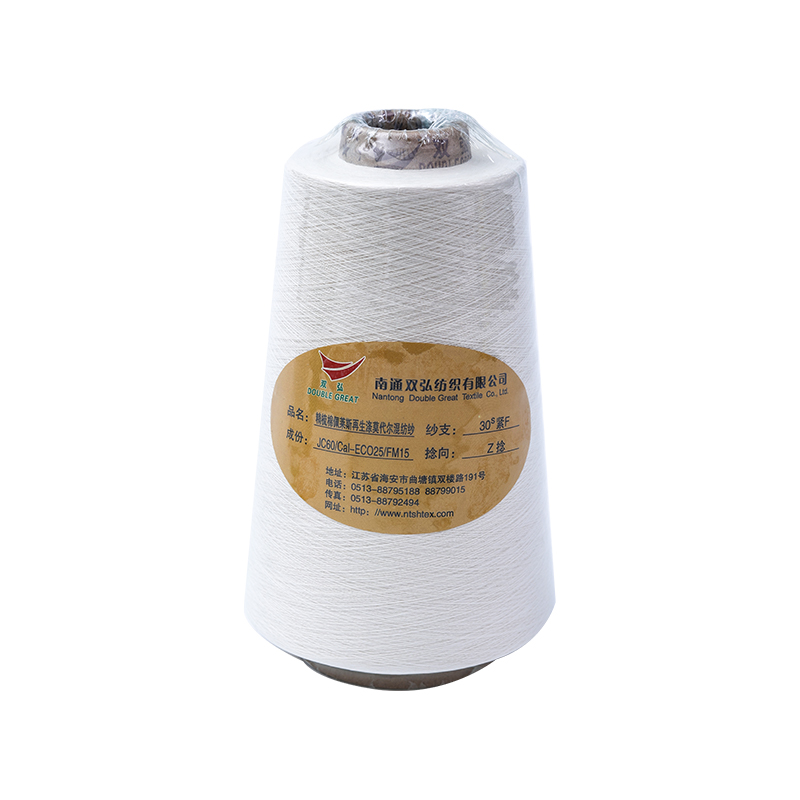
Blended yarn is a single spun yarn made from two or more different fibre types that are mixed together before or during spinning, so that every metre of the finished yarn carries roughly the same fibre composition. That is the definition, and it is worth saying plainly, because most of the confusion around the term comes from mixing it up with two other things: plied yarn and fabric blends.
A 65/35 polyester-cotton yarn is a blended yarn. So is a 60/40 cotton-modal, a 70/30 acrylic-wool, a 55/45 polyester-wool, and a heather grey yarn spun from black and white cotton fibres. In each case the fibres are opened, mixed, carded and drafted together into one strand. The blend is fixed at the spinning stage, not at the weaving, knitting, dyeing or finishing stage.
What a blended yarn is not: it is not two single yarns twisted together. When a cotton yarn and a wool yarn are plied into one thread, the result is a plied yarn, or in fabric form a union fabric. The two components stay physically separate, they take dye differently, and under abrasion they can wear apart at different speeds. That distinction is commercial, not academic. Price, dyeing route and performance are not interchangeable between the two constructions.
So the useful reading of the word "blend" is narrow: a fibre mixture agreed at the spinning stage, with a ratio that is a contractual number rather than a marketing word, backed by test results that can prove it after delivery.
Four Ways Fibres Meet Inside a Yarn
Blend architecture decides almost everything a buyer cares about — dyeing behaviour, pilling, stretch, shrinkage and end-of-life recyclability. Nearly all commercial yarns sit in one of four arrangements.
| Structure | How the fibres sit | Typical example | What it means in production |
|---|---|---|---|
| Intimate blend | Fibres mixed at the blow room or draw frame, then spun as one strand | T/C 65/35, CVC 60/40, cotton-modal 60/40 | Uniform properties along the yarn, one dyeing route for the strand as a whole, performance is an average of both fibres |
| Core-spun | A filament core is covered by a staple sheath, so the blend is radial rather than random | Cotton-spandex core yarn, cotton-lyocell core yarn, sewing thread | Stretch or tensile strength comes from the core, comfort and appearance from the sheath; core positioning must be monitored |
| Plied / union | Two separately spun yarns twisted together after spinning | Cotton warp with a wool weft, some suiting and decorative yarns | Two faces, uneven dye uptake, higher risk of abrasion splitting; often sold as a fabric property rather than a yarn property |
| Melange or colour blend | Dyed or naturally coloured fibres mixed before spinning | Grey heather, black-white nep effect, marl jersey | Speckled appearance achieved without piece dyeing; shade control depends on fibre batching accuracy |
The important point is that only the first two are normally quoted with a blend percentage on a contract. If a specification sheet says "65/35 poly-cotton" without stating the spinning route, you still do not know whether you are buying a ring-spun intimate blend, a compact-spun intimate blend or an open-end yarn with a different hairiness and strength profile. Those three yarns can carry the same ratio and behave completely differently in a knitting machine.
The Ratio Is the Specification: 65/35, 60/40 and Everything Between
Once you accept that blended yarn means a fixed mixture, the next question is the ratio, because the ratio is what actually moves hand feel, strength, price and shrinkage. A blend is not a vague category; it is a number with a tolerance attached.
The most common commercial ratio in the world is 65/35 polyester-cotton, usually written T/C 65/35. It exists because it sits at a practical balance point: enough polyester to hold the fabric's shape and resist abrasion, enough cotton to keep the surface from feeling plastic and to absorb moisture against the skin. Move to 60/40 cotton-rich, often written CVC, and you get a noticeably softer, more cotton-like hand feel at a slightly higher raw material cost and with slightly more pilling risk on the surface.
Ratios below roughly 40% of the minor component start to behave less like a blend and more like the dominant fibre with an additive. A 90/10 polyester-viscose still spins, knits and dyes, but the viscose is contributing a modifier rather than a partner.
| Ratio | Common name | Hand feel | Strength and abrasion | Moisture regain | Typical end use |
|---|---|---|---|---|---|
| 65/35 polyester-cotton | T/C 65/35, PC | Crisp, drier, holds a crease | High | Low, around 4% | Workwear, uniforms, shirting, bed linen, lining |
| 60/40 cotton-polyester | CVC 60/40 | Soft, closer to cotton | Medium to high | Medium, around 6% | Premium shirts, polo, corporate knitwear |
| 50/50 polyester-cotton | PC 50/50 | Balanced | Medium to high | Medium | General shirting, pocketing, lining |
| 65/35 polyester-viscose | T/R 65/35 | Smooth, drapes well | Medium to high | Medium | Suiting, dresses, blouses, trousers |
| 60/40 cotton-modal | Cotton-modal | Very soft, fluid | Medium | High, around 11% | Underwear, T-shirts, sleepwear, premium jersey |
| 70/30 acrylic-wool | Acrylic-wool | Warm, bulky, wool-like | Medium | Medium | Sweaters, socks, accessories |
| 80/20 wool-nylon | Wool-nylon | Warm, resilient | Very high abrasion resistance | Medium | Socks, outerwear, performance knitwear |
A ratio is only meaningful with a tolerance. In practice, a delivered lot is normally accepted at plus or minus three percentage points of the declared minor fibre content, verified by chemical dissolution methods such as ISO 1833 or ASTM D629. Anything tighter has to be agreed in writing before spinning, because fibre blending is a physical process and not a chemical reaction.
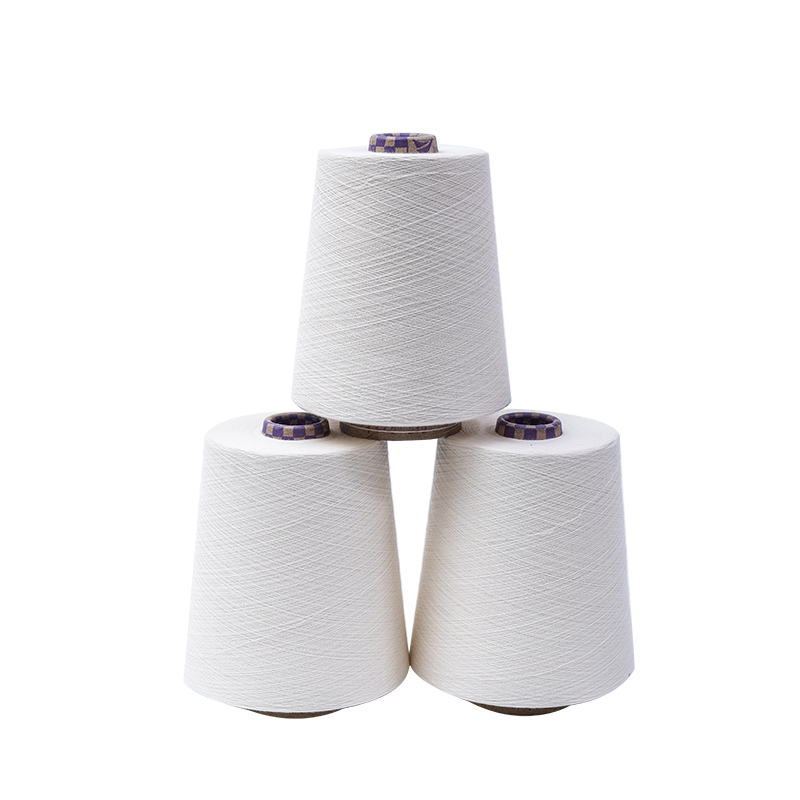 T65/JC35 Polyester Combed Cotton Blended YarnCheck its declared T65/JC35 ratio and 21S–60S counts when comparing blend tolerances and practical performance gains.View Product →
What Blending Actually Buys You
Buyers rarely ask for a blend because they like the word. They ask because one fibre covers the weakness of the other. Below are the six gains that show up most often in costing sheets and in wear trials.
Strength per unit cost
Polyester contributes tensile strength and abrasion resistance at a lower cost than long-staple cotton. In a 65/35 blend the yarn can match or exceed the breaking strength of a comparable pure cotton yarn while using less of the more expensive fibre.
Dimensional stability
Blending polyester into a cotton yarn reduces shrinkage after repeated washing, because the synthetic component does not swell and relax in the same way as cotton. This is one of the main reasons knitwear programmes specify a blend for garments that must keep their size over many home launderings.
Moisture and comfort tuning
Cotton, modal, viscose, lyocell and bamboo all absorb moisture at different rates. Blending lets you dial comfort toward the end use: high absorbency for next-to-skin items, lower absorbency and faster drying for outer layers.
Pilling control
Pilling is driven by fibre strength, length and the number of fibre ends escaping the yarn surface. A carefully chosen blend with a moderate synthetic content and good compact spinning can pill less than a pure synthetic yarn, and less than a loosely spun soft yarn.
Colour and design freedom
Melange blending, cross-dyeing two fibres with different dye affinities, and blending dyed fibres all open design options that single-fibre yarns cannot reach. A heather effect can be built into the yarn rather than applied later.
Compliance and recycled content
Recycled polyester, eco viscose and bio-based fibres are normally introduced through blends. A 50/50 recycled polyester-cotton yarn can carry verified recycled content while keeping the handle and strength targets of the original programme.
The gains are real, but they are averages. A blend does not deliver the best of both fibres everywhere; it delivers a weighted result. If a test method rewards moisture absorbency, the blend will usually score below the absorbent fibre alone. If a test rewards abrasion cycles, it will usually score above the natural fibre alone.
Where Blends Go Wrong: Seven Failure Modes Worth Budgeting For
Most blend complaints that reach a mill are not about the concept, they are about execution. These are the areas that generate claims, and each has a practical countermeasure.
- Ratio drift between lots. Fibre bale laydown variation, waste recovery and reclaimed fibre reintroduction all shift the effective ratio. Countermeasure: draw-frame blending with an agreed ratio tolerance, plus retained samples from every lot.
- Uneven dyeing. Two fibres with different dye affinities need either a union dyeing route that shades both to the same depth, or a deliberate cross-dyeing route that produces two tones. Choosing the wrong one produces barré and streaks, not a colour.
- Pilling and fuzzing. Short fibres, insufficient twist and high hairiness all raise pilling. Countermeasure: combed cotton components, controlled twist and compact spinning to reduce protruding fibre ends.
- Heat sensitivity. Polyester softens well below the temperature at which cotton chars. Pressing and heat-setting windows must be set for the lowest-temperature fibre in the blend, not the highest.
- Static and fly. Synthetic-rich blends generate static in dry knitting rooms, causing fly accumulation and drop-outs. Countermeasure: humidity control and appropriate conditioning before knitting.
- Contamination. Foreign fibres, coloured specks and packaging fragments are far more visible in a uniform blend than in a slub or fancy yarn. Countermeasure: contamination-controlled bale selection and electronic clearing at winding.
- End-of-life recycling limits. Intimate blends are hard to separate mechanically, so a mixed-fibre garment is usually downcycled rather than returned to fibre. If circularity is a stated goal, plan the blend with the recovery route in mind from the beginning.
How a Blend Is Built Inside a Spinning Mill
The difference between a good blend and a cheap blend is usually decided in the first three processes, long before the yarn reaches a knitting machine. Fibres of different lengths, deniers and densities tend to separate during opening and carding if the mixing stage is chosen carelessly.
There are two main mixing points. Blow room blending mixes opened fibre tufts before carding. It is efficient and suitable for man-made fibres of similar length and denier, but ratio control is coarser. Draw frame blending mixes slivers at the drawing stage, typically two to six slivers of different composition feeding one delivery. It gives tighter ratio control and is the standard route when cotton is blended with a fibre of very different length, such as wool, linen or a long-staple synthetic.
Illustrative blend ratio control by mixing method (typical spread of minor fibre content around the target)
After mixing, the route continues through carding, optional combing for the cotton component, drawing, roving, spinning and winding. Each stage has a specific role in keeping the blend honest:
- Fibre selection and bale laydown. Fibre length, micronaire, denier, crimp and colour are matched to the target yarn count and to the blend ratio.
- Opening and blending. Tufts are opened and mixed to the intended composition; the mixing point is chosen according to fibre length difference.
- Carding. Fibres are separated into a web and formed into sliver; neps, seed fragments and short fibre are reduced.
- Combing (when specified). Short fibre and impurities are removed from the cotton component, which lifts strength and lowers hairiness.
- Drawing. Slivers are doubled and drafted to level count variation and to build the final ratio.
- Roving. The drawn sliver is drafted and lightly twisted into a package suitable for spinning.
- Spinning. Ring spinning, compact spinning or rotor spinning imparts the final twist and structure.
- Winding and clearing. Electronic clearers remove thick places, thin places, neps and foreign material, and splices replace knots.
- Testing and release. Count, unevenness, IPI, tenacity, elongation and moisture regain are checked before the lot is released.
The Numbers That Prove a Blend Is What It Claims to Be
A blend percentage on a label is a claim. A set of test values is evidence. When a yarn lot arrives, these are the measurements that tell you whether the specification was met, and they are the ones to require in a pre-shipment report.
| Test value | What it controls | Risk if out of specification |
|---|---|---|
| Blend ratio by chemical dissolution | Declaration accuracy and duty classification | Label claim failure, customs queries, customer claims |
| Count and count CV | Fabric weight per square metre, machine gauge | Weight deviation, needle lines in knitting |
| Unevenness CVm and IPI | Visual evenness of the finished fabric | Cloudy appearance, barre in dyeing |
| Tenacity and elongation | Ends down in spinning, weaving and knitting | Yarn breaks, machine stops, lower efficiency |
| Twist per metre and twist CV | Hand feel, pilling, spirality in single jersey | Skewing garments, surface pilling |
| Hairiness index | Surface fuzz, pilling tendency, comfort | Pilling, blurred print, rough handle |
| Neps per kilometre | Visual defects after dyeing | Dark or light specks that only show after finishing |
| Moisture regain at delivery | Commercial weight, storage, downstream processing | Weight disputes and conditioning claims |
Fibre-length-related defects are worth a separate note. In a blend, a length mismatch between the two components causes drafting irregularities that appear as periodic thick and thin places. These do not always show in the grey yarn; they frequently appear after dyeing as a repeating shadow along the fabric. This is why drawn sliver evenness and combed noil control matter more in a blend than in a single-fibre yarn.
Testing capability is therefore part of the product, not a back-office function. Nantong Double Great Textile operates a central laboratory that has passed CNAS accreditation and runs USTER testing equipment on the spinning lines, which is documented in the company's laboratory accreditation record. For a buyer, the practical value is simple: the test report that accompanies the lot is generated in-house, on the same equipment used to control production, rather than sourced after the fact.
Core-Spun Yarn: A Blend in a Different Direction
Core-spun yarn deserves separate treatment because it answers a question that an intimate blend cannot. When a garment needs stretch or very high tensile efficiency, mixing staple fibres randomly is not enough; you need an elastomeric or high-tenacity filament running down the centre of the yarn with staple fibres wrapped around it.
The construction is radial. A bare spandex filament, or a polyester or nylon filament, is fed through the front rollers while the drafted staple roving wraps around it. The result behaves like two yarns in one: the core carries load and recovery, the sheath carries appearance, moisture management and skin contact.
Three parameters decide whether a core-spun yarn performs: core draft ratio, sheath coverage, and core centring. A low draft ratio produces a yarn that has not developed enough stretch. Poor sheath coverage exposes the core, which then shows as a shiny line in the fabric. Off-centre cores produce uneven dyeing and spirality. All three are controllable and testable, but only if the specification names them.
 Cotton Core Spun Yarn for Uniforms and ShirtsReview core draft, coverage, and centring specifications when sourcing this 21S–60S core-spun cotton for uniforms and shirts.View Product →
Recycled, Bio-Based and Functional Blends
The fastest-growing part of the blended yarn market is not about cost at all. It is about meeting a material target set upstream — a recycled content percentage, a bio-based share, or a functional property that a pure natural fibre cannot deliver.
Mechanically recycled polyester from post-consumer bottles is now routinely blended with cotton at 50/50 or 65/35. The spinning challenges are real: recycled fibre often has a wider denier distribution and more colour variation than virgin fibre, which shows up as neps and inconsistent dye uptake. The countermeasures are tighter bale selection, additional cleaning points and, at the yarn stage, more conservative clearing settings.
Functional blends follow a different logic. Here the additive fibre carries the performance claim: antibacterial silver or zinc chemistry, far-infrared ceramic particles, flame-retardant chemistry, graphene, or UV-blocking mineral particles. The blend ratio is usually small — often five to fifteen percent — but the fibre must be distributed evenly, otherwise the claim fails in the areas where the additive is missing.
Recycled polyester blends
Post-consumer and post-industrial polyester blended with cotton or viscose for recycled content targets, usually verified through a chain-of-custody standard. Suitable for knitwear, uniforms and casualwear.
Bio-based and biodegradable fibres
PLA, bio-polyamide and bio-based acetate blended with cotton or lyocell to reduce fossil content while keeping a stable spinning performance.
Antibacterial blends
Antibacterial polyester or viscose blended with cotton or modal for next-to-skin and medical-adjacent textiles that must survive repeated industrial laundering.
Far-infrared and thermal blends
Ceramic-modified fibres blended into staple yarns for warmth retention in outerwear and thermal underwear without adding weight.
Flame-retardant blends
Inherently flame-retardant fibre blended with recycled polyester for protective workwear, where wash durability of the flame resistance is the specification that matters.
Graphene and conductive blends
Small percentages of graphene-modified fibre dispersed through a staple blend for antistatic and thermal-regulation properties in technical knitwear.
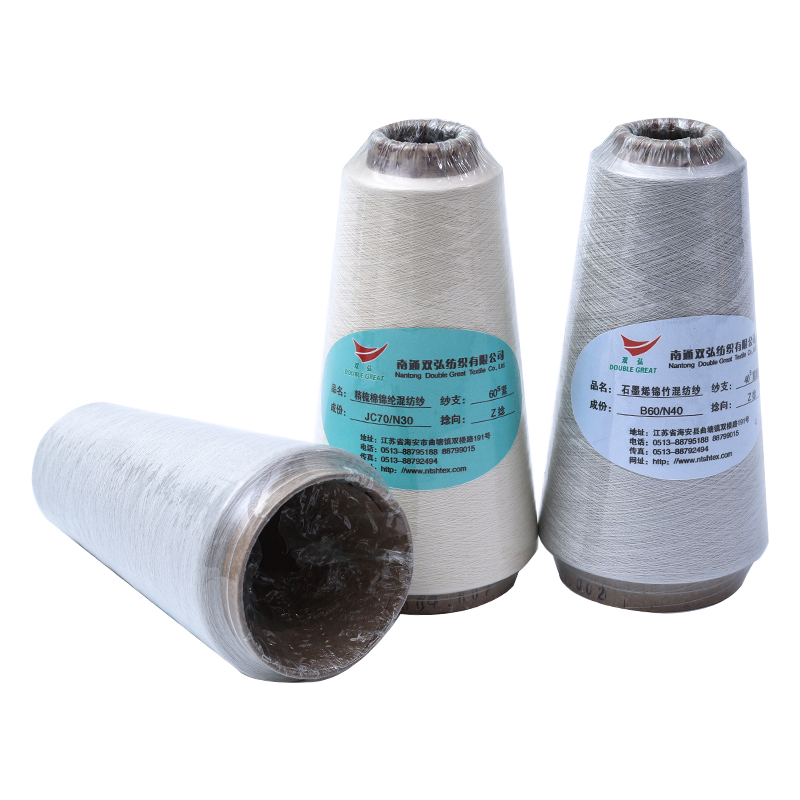 Graphene Yarn-Tex for Functional Technical KnitwearGraphene-modified staple blend yarn with antistatic and far-infrared functions, available in JC60/TSMX40 and TSMX100% specifications from 21S–60S.View Product →
Matching the Blend to the End Use
Blend selection is a process of elimination. Start with the dominant performance requirement of the finished article, then choose the fibre combination that reaches it at an acceptable cost, then confirm that the spinning route can deliver the count and evenness required.
| End use | Dominant requirement | Common blend choice | Watch out for |
|---|---|---|---|
| Workwear and uniforms | Abrasion resistance, colour retention, industrial laundering | T/C 65/35 or 50/50 | Pilling at collar and cuff, shade change after repeated washes |
| Premium shirting | Hand feel, drape, appearance | CVC 60/40, cotton-modal, cotton-lyocell | Surface neps, uneven dye uptake in the modal component |
| Activewear and next-to-skin | Moisture transport, stretch, odour control | Polyester-viscose-spandex core, cotton core yarn, antibacterial blends | Core centring, spirality in single jersey, wash durability of the finish |
| Denim and woven bottoms | Strength, stretch recovery, abrasion resistance | Cotton core yarn with spandex, cotton-polyester blends | Skewing after wash, core show-through, shade variation between lots |
| Sweaters and knitwear | Warmth, bulk, softness | Acrylic-wool 70/30, wool-nylon 80/20, wool-silk | Hairiness, pilling under the arm, felting shrinkage in wool-rich blends |
| Home textiles and bed linen | Dimensional stability, wash durability | T/C 65/35, CVC 60/40 | Shrinkage tolerance, colour fastness to light |
| Socks and accessories | Abrasion at heel and toe, elastic recovery | Wool-nylon 80/20, cotton core yarn with spandex | Hole formation, twist liveliness causing needle drop |
A note on certification-driven blends. If the material claim is part of the marketing message — recycled content, organic cotton, responsible viscose — the blend composition has to be traceable through the whole chain, not only at the yarn stage. This usually means a documented input declaration, lot-level segregation and, where required, third-party chain-of-custody certification. Retrofitting traceability onto a running programme is far more expensive than designing it in from the start.
How to Write a Blended Yarn Enquiry That Gets an Accurate Quotation
Vague enquiries produce quotations that cannot be compared, because the mill is forced to make assumptions and each assumption changes the price. The following list covers the information a spinning mill needs to quote a blend precisely and to keep a running programme repeatable across lots and years.
- Fibre composition and ratio in percentage terms, with the tolerance you can accept, stated as a plus or minus figure.
- Yarn count and system, for example Ne 30/1 ring spun, Ne 20/1 compact, Ne 12/1 rotor, plus the expected count deviation.
- Spinning route if it affects performance, such as ring, compact or rotor, and whether combed cotton is required.
- End use and process route, so the mill can advise on twist, hairiness and clearing targets instead of guessing.
- Colour requirement: raw white, dyed, melange, or cross-dyeable. This determines whether dyed fibres must be blended in.
- Physical targets for tenacity, elongation, IPI and neps, or a reference USTER percentile you are working to.
- Certification requirements for recycled, organic, responsible viscose or other claims, including whether chain-of-custody documents are needed.
- Packaging and delivery: cone type and weight, bag and carton format, pallet configuration, and whether humidity protection matters for long sea transit.
- Order structure: sample quantity, first bulk quantity, repeat volume and the expected programme life.
- Testing and acceptance: which values must appear on the lot report, and which third-party tests you will run independently.
The last point is often where money is saved or lost. A programme with a clearly defined acceptance test rarely reaches a dispute, because both sides know what the lot report has to show before shipment. That is also how a mill with a long-standing yarn manufacturing background can be held to a consistent standard across repeated orders rather than being judged on a single lucky lot.
Frequently Asked Questions About Blended Yarn
What does blended yarn mean in one sentence?
It means a single yarn spun from two or more different fibre types that are mixed before or during spinning, so the fibres are distributed throughout the strand rather than existing as separate plied components.
Is blended yarn weaker than 100% cotton?
Usually it is stronger in tensile and abrasion terms when polyester is the partner fibre. A 65/35 polyester-cotton yarn typically breaks at a higher load than a comparable pure cotton yarn, and it loses less strength after repeated abrasion. The trade-off appears in moisture absorbency and in the hand feel, which move away from cotton.
What is the difference between CVC and T/C?
CVC means chief value cotton: the cotton content is above 50%, typically 60/40. T/C means the polyester content is dominant, typically 65/35. CVC feels softer and costs more; T/C is more durable and holds shape better.
Can a blended yarn be dyed to one solid colour?
Yes, but it requires a union dyeing route that shades both fibres to the same depth. If the two fibres have very different dye affinities, achieving a solid shade needs either dyes selected for both components or a fibre that has been solution-dyed or dope-dyed before spinning.
Why does blended fabric pill more than expected?
Pilling is driven by short fibres escaping the yarn surface, low twist, and the strength of the fibre that forms the pill anchor. Blends with a strong synthetic component can hold a pill on the surface once it forms, which makes pilling more visible than in a weaker pure yarn. Combed fibre, controlled twist and compact spinning are the usual corrections.
Does blended yarn shrink?
Less than pure cotton in most cases, because the synthetic component does not swell and relax the same way. The residual shrinkage figure depends on the blend ratio, the finishing route and the fabric structure, so it should be specified as a tested value rather than assumed.
How is the blend ratio verified after delivery?
By chemical dissolution of one fibre component, using methods such as ISO 1833 or ASTM D629, on a representative sample drawn from the lot. The result is compared with the declared ratio and the agreed tolerance.
Is core-spun yarn a blended yarn?
It is a composite yarn, and it works on a different principle. An intimate blend distributes fibres randomly through the cross-section. A core-spun yarn places a filament core in the centre with staple fibres wrapped around it, so the properties are layered rather than averaged.
Can blended yarn be recycled at end of life?
Mechanically, blended yarns are difficult to separate back into their component fibres, so mixed-fibre textiles are more often downcycled into lower-value applications. If circularity is a programme goal, choose blends whose components can be handled by the available recovery route, or specify a mono-material construction.