 English
 русский
 Español

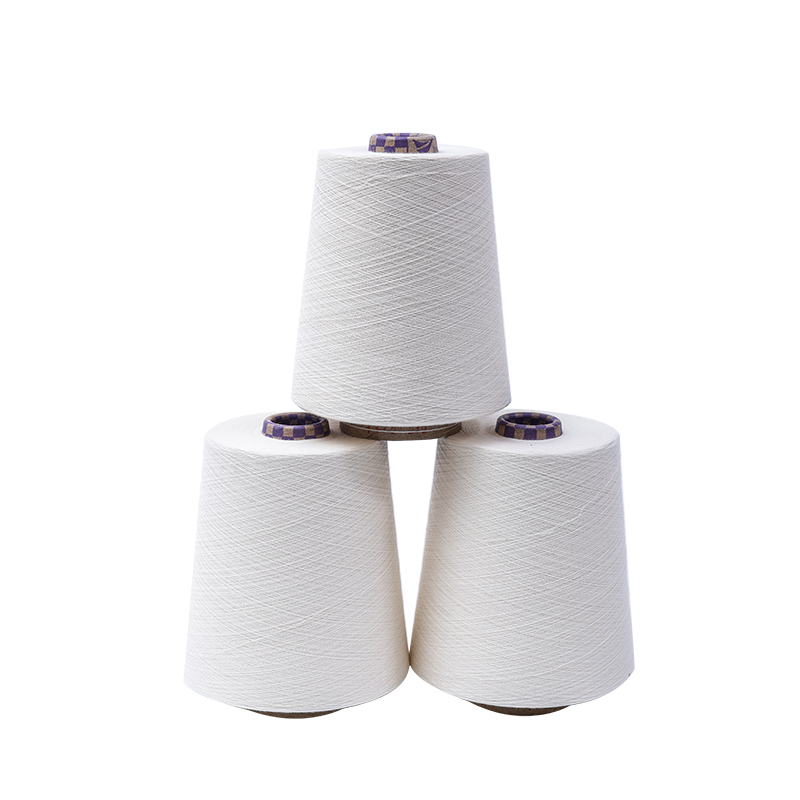
Two cones of Ne 30 yarn, both labelled 65/35, both ring-spun, both the same shade of ecru. One is polyester-viscose, the other polyester-cotton. On the creel they look like twins. Run them through the same circular knitter, the same dye vessel and the same wash test, and within a week they stop being twins: one fabric grows in the length direction after washing, the other holds its dimensions but feels drier against the skin.
That gap is not a defect. It is the predictable outcome of swapping one cellulosic fibre for another, and it touches everything a buyer cares about: handle, moisture behaviour, pilling, dye recipe, shrinkage allowance, and the landed cost per kilogram of finished fabric. This page walks through the comparison at the fibre level, at the spinning frame, in the dye bath, and on the cost sheet.
The Short Answer: One Fibre Swap, Seven Changes
Polyester-viscose, often written PV, P/V or T/R in mill shorthand, blends polyester staple with viscose rayon staple. Polyester-cotton, written TC when polyester is dominant or CVC when cotton is dominant, blends polyester staple with cotton. Both are normally ring-spun. Both can be carded or combed. Both are sold at 65/35, 67/33, 50/50 or 80/20. The difference sits entirely in the cellulosic partner, and that partner decides seven behaviours.
- Moisture handling. Viscose has a regain near 13%, cotton near 8.5%, polyester near 0.4%. At 65/35, that puts the viscose blend roughly one and a half percentage points wetter in equilibrium.
- Strength in the wet state. Viscose falls to about half of its dry tenacity when saturated. Cotton rises slightly. A garment that is washed hot and tumble-dried will behave differently depending on which one carries the load.
- Stiffness and drape. The initial modulus of viscose is low, so the fibre bends easily and the fabric flows. Cotton is stiffer, which reads as crispness and body.
- Pilling. Viscose pills form and then shear away relatively cleanly. In polyester-cotton, the polyester pills are anchored by the cotton fibre network and stay on the surface longer.
- Colour yield. Viscose's amorphous regions take reactive dye readily, so a PV fabric reaches the same depth with less dye and less salt than a PC fabric.
- Dimensional stability. Viscose relaxes and shrinks on first wetting unless it is compacted or pre-relaxed. Cotton has its own shrinkage curve but can be mechanically controlled by compressive shrinking.
- Static. Because viscose holds more moisture, a PV yarn dissipates static better than a PC yarn of the same polyester content.
A working rule from knitting floors: if the fabric must feel cool and fluid within the first few seconds against skin, specify PV. If it must hold a crease, survive repeated industrial washing, or carry a print with sharp edges, specify PC.
Viscose and Cotton Inside the Blend
Viscose: Soft, Absorbent, Weak When Wet
Viscose is regenerated cellulose. Wood pulp is dissolved, extruded through a spinneret, regenerated in an acid bath and cut into staple, typically 38-40 mm long at 1.2-1.5 dtex. Because the fibre is engineered rather than grown, it arrives at the mill with almost no length variation, no trash, no seed-coat fragments and very few neps. That uniformity is why a viscose blend drafts cleanly and produces an even yarn with modest machinery effort.
The trade-off is mechanical. Dry tenacity sits around 2.0-2.6 cN/dtex, below cotton, and the wet modulus is low enough that a saturated viscose fibre deforms under its own fabric weight. In a blend, the polyester carries most of the tensile load; the viscose contributes softness, absorbency and a cool initial touch. It is also the component that limits how aggressively you can caustic-scour, bleach or mercerise the finished fabric.
Cotton: Stable, Crisp, Stronger When Wet
Cotton is a natural staple with a length distribution from roughly 27 mm to 38 mm depending on origin and grade, plus a short-fibre fraction that shows up as neps and hairiness. It carries natural waxes and pectins that must be scoured before dyeing, and it holds a small amount of trash that opening and carding must remove. In exchange it offers a dry, slightly rough touch, good body, and the unusual property of gaining strength when wet, up to 110-120% of dry tenacity.
That wet-strength behaviour is the reason cotton-rich blends dominate workwear, uniforms, bed linen and any product that faces industrial laundering. It is also why a PC fabric can be scoured and bleached in strong alkali without the tenacity loss that would damage a PV fabric.
The Polyester Backbone
Both blends usually use 1.2-1.4 dtex semi-dull polyester staple at 38 mm, sometimes 1.4 dtex bright for a sharper lustre. The polyester controls strength, crease recovery and dimensional stability, and it sets the dyeing ceiling at 130 degrees C for disperse dye. Change the polyester specification, and both blends shift together. Change the cellulosic partner, and they diverge.
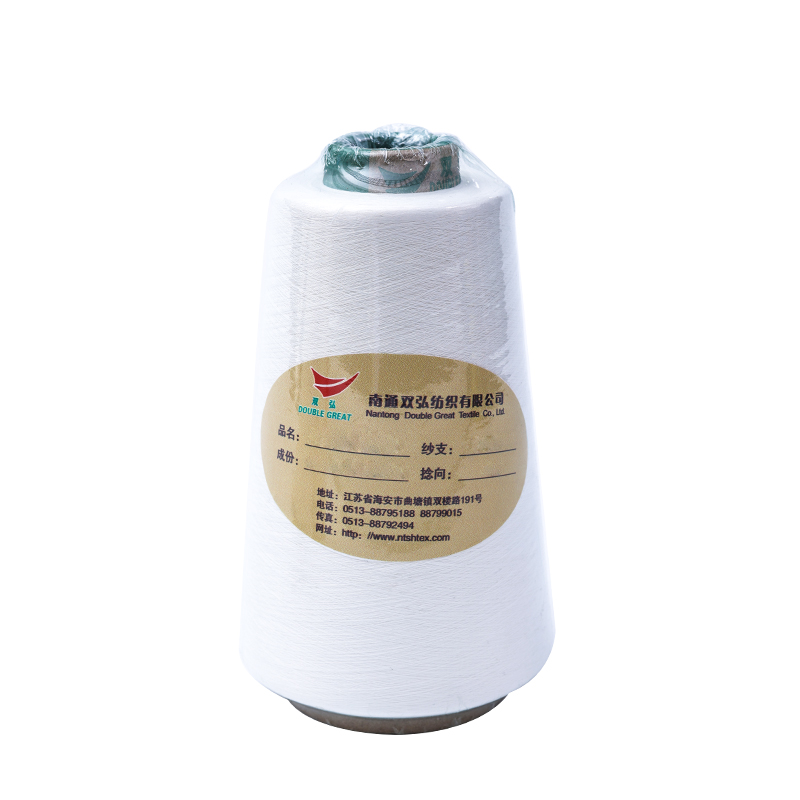 Polyester/Viscose Blended Yarn for Apparel and Home TextilesOffered in T65/R35 and T50/R50 with counts 21S–60S, combining polyester strength with viscose softness for garments, bedding, curtains and industrial textiles.View Product →
Side-by-Side: Polyester-Viscose vs Polyester-Cotton
The table below condenses the properties that most often decide a specification. Values refer to 65/35 ring-spun blends in the Ne 20-40 range unless stated otherwise; individual results move with fibre source, combing, twist and finishing.
| Property | Polyester-viscose (PV / T/R) | Polyester-cotton (TC / CVC) |
|---|---|---|
| Cellulosic partner | Viscose rayon staple, 38-40 mm, 1.2-1.5 dtex | Cotton, 27-38 mm, variable length distribution |
| Moisture regain of the yarn | 4.5-5.5% | 3.0-3.8% |
| Dry tenacity of the yarn | 13-16 cN/tex | 15-19 cN/tex |
| Strength when saturated | Falls to about half of dry tenacity | Retains or slightly gains |
| Handle | Cool, fluid, low bending stiffness | Dry, crisp, more body |
| Pilling behaviour | Pills shear off relatively cleanly | Polyester pills stay anchored longer |
| Alkali resistance | Poor; swells and loses strength in caustic | Good; tolerates mercerising and strong scour |
| Reactive dye uptake | High; less dye and less salt required | Moderate; more salt and alkali required |
| Shrinkage control | Compaction or pre-relaxation needed | Compressive shrinking plus pre-shrink |
| Static build-up | Lower | Higher |
| Main cost driver | Dissolving pulp price and energy | Cotton lint basis and combing noil |
| Typical end use | Knit tops, dresses, linings, sleepwear, soft shirting | Workwear, uniforms, shirting, bed linen, prints |
On the Spinning Floor: Card, Comber and Ring Frame
Opening and Carding
Viscose opens easily and cards at high rates with low nep generation, but it is sensitive to dry air. Below about 50% relative humidity, the fibre throws static, laps stick to the cylinder and sliver quality drops. Mills running PV usually hold the card room at 55-60% RH. Cotton needs the opposite emphasis: aggressive opening with good trash extraction, because seed-coat fragments and dust that survive carding will appear as dark specks after dyeing.
Combing and Noil
Fine polyester-cotton counts are normally combed. Combing removes 12-18% of the fibre as noil, lifts the nep count out of the sliver and improves yarn evenness, but it adds real cost to the kilogram price. Viscose rarely needs combing because it has no short-fibre fraction to remove; the money is better spent on draw-frame levelling and on tighter count control at the ring frame.
Drafting, Twist and Hairiness
Because viscose fibre is weaker, PV yarns break more often at high spindle speeds and need gentler balloon tension, lower traveller weights and a slightly higher twist factor to reach the same tenacity target. A typical knitting twist multiplier for PV sits around 3.6-4.0, against 3.4-3.8 for PC. Set the twist too low on PV and the fabric will not pill less; it will simply deform more in the wash.
Hairiness follows a similar pattern. PC yarns carry more protruding fibre ends from the short-fibre fraction, which is fine for brushed and raised finishes but shows as cloudiness in a dark reactive shade. PV yarns are visibly cleaner on the cone, which is one reason they suit fine-gauge knitting and lightweight lining fabrics.
Dyeing and Finishing: Where the Cost Gap Opens
The Alkali Question
Both blends require a two-stage colour route: disperse dye for the polyester at 130 degrees C and pH 4-5, then a reactive or direct dye for the cellulosic component at 60-80 degrees C in alkaline conditions. The difference is how much alkali the cellulosic partner can take. Cotton is comfortable in strong caustic soda; it is routinely mercerised to improve lustre, dye yield and strength. Viscose swells by 40-50% in volume in strong caustic, loses tenacity, and can crease permanently if it is held under tension in rope form. PV therefore runs with low-alkali reactive systems, longer liquor ratios and gentler winch or overflow processing.
Colour Consistency
Viscose's high dye uptake is an advantage in depth but a risk in consistency. Batch-to-batch shade variation shows up faster in PV because the fibre absorbs unevenly if the blend itself is uneven. A well-controlled PV yarn with a coefficient of variation of mass under 12% will dye level; a poorly blended one will show a frosted or heather-like face after reactive dyeing, and no amount of shading addition will fix it. PC is more forgiving in shade but demands more salt, more alkali and more washing-off, which pushes water and effluent cost upward.
Choosing the Blend for the Garment
Most sourcing decisions come down to four questions: how the fabric feels in the first five seconds, how it survives washing, what surface effect is needed, and what the target cost per garment is. These cards map the two blends onto common product types.
Knit tops and T-shirts
PV wins on drape and cool touch at 160-220 gsm single jersey. PC stays crisper and holds shape better in heavier weights above 220 gsm.
Soft shirting
PV at Ne 40-60 with a compact-spun yarn gives a light, fluid hand. PC with combed cotton gives a drier, more traditional shirt feel and better crease retention.
Workwear and uniforms
PC, usually CVC 60/40 or 65/35, because industrial washing, chlorine bleach and hot pressing punish viscose severely.
Linings and sleepwear
PV dominates. Low bending stiffness, smooth surface and better static dissipation matter more than wet strength here.
Bed linen and home textiles
PC, particularly where repeated hot washing and print sharpness are required. PV can work in decorative cushions but ages poorly under frequent laundering.
Print bases
PC gives sharper edges because the fabric does not flow under the screen. PV gives a softer, more blended print aesthetic but requires tighter tension control.
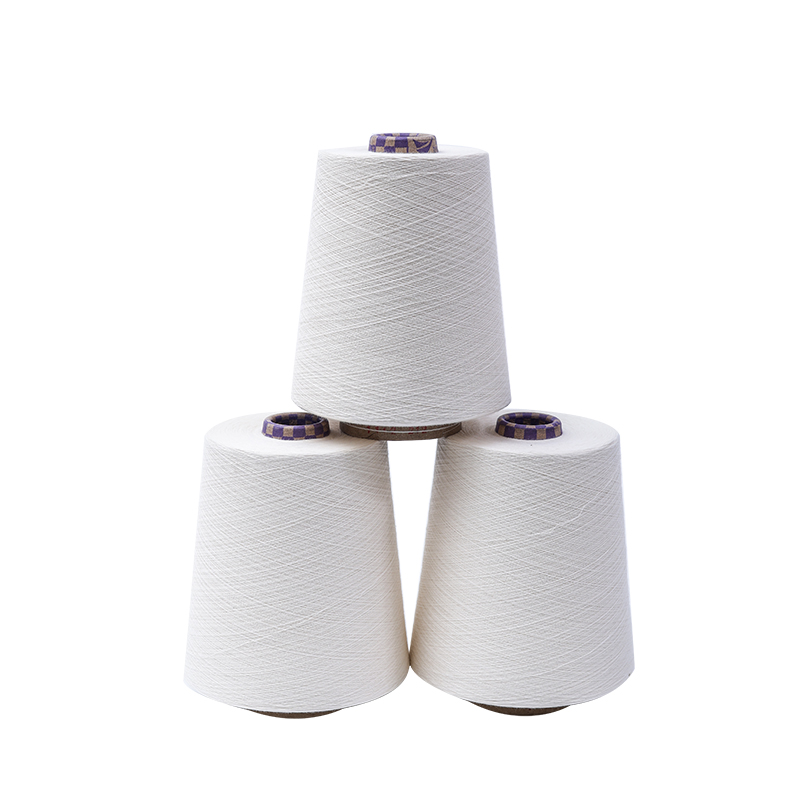 Polyester/Combed Cotton Blended Yarn for Shirts and BeddingT65/JC35 yarn in 21S–60S uses combed cotton and polyester to offer softness, breathability, wrinkle resistance and shape retention for shirts, T-shirts and bedding.View Product →
Price, Yield and Supply Risk
Cost comparisons move constantly, so the useful approach is to understand what drives each number rather than to memorise a quote. Viscose staple price tracks dissolving pulp, caustic soda and energy, and it has run through wide swings in recent years as pulp availability changed. Cotton tracks the ICE No. 2 contract plus origin basis, freight and, in some markets, policy factors that can separate domestic and imported prices sharply. A PV blend is usually the more stable of the two on a three-month horizon; a PC blend can move 10-15% in a quarter when the cotton basis shifts.
Yield matters as much as the fibre price. Viscose at 1.38 dtex has a slightly lower density than cotton, so the same linear density of yarn covers marginally more length per kilogram, and a PV fabric often needs less weight per square metre to reach the same opacity. Offsetting that, PV needs a higher shrinkage allowance and more careful compaction, which consumes finishing capacity.
What to Put in the Specification
Blend ratio alone is not a purchase specification. Two mills can deliver "65/35 PV, Ne 30" and produce fabrics that behave quite differently. These are the points worth writing into the order, with tolerances that reflect normal ring-spinning capability.
- Blend ratio with a tolerance. State 65/35 plus or minus 3 percentage points, measured by chemical dissolution, not by counting fibres.
- Count and count CV. Nominal count in Ne or tex, with a coefficient of variation at or below 1.5% across the shipment.
- Evenness and IPI. USTER CVm at or below 12.0% for combed counts and thin places, thick places and neps quoted per kilometre against a stated sensitivity.
- Tenacity and elongation. For 65/35 PV at Ne 30, expect 13-16 cN/tex and 6-9% elongation; PC of the same count usually runs 15-19 cN/tex.
- Twist level and twist CV. Twist per metre or twist multiplier, with a CV at or below 5%, because twist variation shows as barré in knitted fabric.
- Moisture regain basis. Agree the commercial mass convention, since viscose blends can gain or lose 2% of weight with the weather in an unventilated warehouse.
- Shrinkage after washing. Quote length and width change after three cycles at 40 degrees C, with a limit around 3%.
- Colour fastness. Change of shade and staining at grade 4 or better for washing and rubbing, and light fastness matched to the end use.
Ask for the test method with the value. A tenacity figure without a standard, or a shrinkage figure without a wash cycle, cannot be held against a supplier later. Mills with in-house laboratory accreditation can usually supply the full package with the shipping documents, which shortens approval cycles considerably. More on the ratio benchmarks behind these numbers is available in the blend ratio and buying guide.
 Polyester/Viscose Spandex Core Spun Yarn for Stretch FabricsT70/R30 core-spun yarn in 16S–60S combines a polyester core, viscose cover and spandex stretch for knitwear, jeans, sportswear and swimwear.View Product →
Five Buying Mistakes
- Treating PV as a cheap substitute for PC. The raw material cost per kilogram is not automatically lower, and the finishing allowance is usually higher. Budget for compaction and a higher shrink allowance.
- Running a caustic mercerising step on PV. The fabric will look bright for one season and then fail on tear strength. If lustre is required, specify a bright polyester component instead.
- Approving a PV fabric from a lab dip only. Viscose blend appearance depends on yarn evenness, so the bulk fabric can show streaks that a small dip cannot reveal. Ask for a piece-dyed bulk sample of at least 20 metres.
- Ignoring the moisture regain clause. Without an agreed convention, a shipment weighed in a humid week can gain weight that later shows up as a count deviation in the finished fabric.
- Comparing quotations at different twist levels. A lower twist factor saves money at the spinning mill and costs money at the knitting machine, because barré and deformation appear later in the chain.
FAQ
Is polyester-viscose the same as T/R?
Yes. T/R comes from the older shorthand for tetoron (polyester) and rayon (viscose). PV, P/V and T/R all describe the same blend family, and the ratio still needs to be stated separately.
Which blend pills more, PV or PC?
In dry abrasion, polyester-cotton usually keeps its pills visible for longer because the cotton fibre network anchors them. PV pills form too, but the viscose component wears away and the pills detach sooner, so the fabric looks cleaner after ten to twenty wears.
Can polyester-viscose be mercerised?
Not in the conventional strong-caustic process. Viscose swells heavily and loses tenacity. A mild alkaline treatment is possible, but if a mercerised look is essential, a cotton-rich blend is the correct choice.
Why does my PV fabric shrink after the first wash?
Viscose relaxes and contracts when it first wets out, and the effect is larger if the yarn was spun at high tension or the fabric was dried under stretch. Pre-relaxation, compaction or a garment wash before cutting brings the residual shrinkage into the 2-3% range.
Is polyester-cotton stronger than polyester-viscose?
At the same count and twist, yes, typically by 15-20% in dry tenacity and far more in the wet state. That is why workwear, uniforms and industrial laundry programmes default to cotton-rich blends.
Which blend takes print better?
PC, because the fabric is stiffer and holds registration under the screen. PV prints well in soft-hand applications but needs tighter tension control and a careful drying profile to avoid distortion.
Can the two components be dyed in one bath?
Not in a single stage. Disperse dye needs 130 degrees C and acidic conditions; reactive dye needs alkaline conditions at 60-80 degrees C. A one-bath two-step route is possible with selected dye systems, but most mills still run two stages for shade reliability.
What count range suits each blend?
Both run comfortably from Ne 20 to Ne 60 in ring spinning. Below Ne 20 the difference in hand becomes less important; above Ne 50, PV's cleaner fibre distribution gives it an advantage in evenness, while PC needs combing to compete.
Approval usually comes down to two samples on a table: a greige cone for count, twist and evenness, and a 20-metre piece-dyed length for shade, shrinkage and handle. Run the wash test on the dyed piece before signing anything, and record the exact cycle. That record becomes the reference point for every later shipment, and it settles most arguments about whether a fabric changed or a customer's laundry changed. For background on the spinning and testing capability behind these specifications, the company profile and laboratory accreditation details are a useful starting point.