 English
 русский
 Español
A home sewer finishes a rice-filled heating pouch on a Sunday afternoon, grabs a spool of leftover cotton polyester blend yarn for the topstitching, and runs the bag for ninety seconds. The cotton shell looks fine, but the stitched seams have stiffened, puckered, and let off a faint chemical smell. Nothing caught fire this time — yet the pouch is now a different product: one with heat-weakened seams sitting directly against hot, moist filling.
Scenarios like this explain why the question "can cotton polyester blend yarn be used in the microwave" keeps resurfacing in sewing forums, handmade-gift communities, and product development meetings for heated comfort goods. So here is the direct answer first: no, cotton polyester blend yarn should not be used in any item intended for microwave heating. The cotton portion of the blend tolerates dry heat reasonably well, but the polyester portion softens and shrinks at temperatures that microwave hot spots reach routinely. Softened polyester can stick to skin, distort seams, and release irritating fumes. For anything that goes into a microwave — rice bags, hand warmers, heating compresses, grain-filled plush toys — 100% natural fiber yarn, most commonly 100% cotton for both the shell fabric and the sewing thread, is the accepted specification.
Quick Answer
Cotton polyester blend yarn is not microwave safe. Polyester softens well below its melt point, and hot spots inside dry fillings can push past that softening range within seconds. Use 100% cotton, wool, or linen yarn and thread for anything you heat, and keep cotton polyester blends where they genuinely excel: apparel, bedding, and durable home textiles.
What Actually Happens to Cotton Polyester Blend Yarn Inside a Microwave
A microwave oven does not heat the way a conventional oven or an iron does. It generates an alternating electromagnetic field that makes polar molecules — water above all — flip back and forth billions of times per second, and that molecular friction is the heat. A material's behavior in a microwave therefore depends on how much moisture it holds and how evenly that moisture is distributed, not simply on the temperature around it. This single fact explains most of what goes wrong when blended yarn meets a heating bag.
Polyester Melts, Cotton Only Scorches
The two fibers inside a cotton polyester blend react to heat in fundamentally different ways. Polyester is a thermoplastic: it softens as it warms and melts at roughly 250-260 °C, with shrinkage and stiffening appearing at far lower temperatures under sustained dry heat. Cotton is a natural cellulose fiber with no melt point at all — it releases absorbed water first, scorches after prolonged exposure, and eventually chars, but it never turns liquid or sticky.
Approximate temperature at which common textile fibers structurally fail
Microwave hot spots change the practical picture. Fire-safety investigations of overheated homemade heating bags have recorded filling temperatures well above the boiling point of water, and localized dry pockets can climb high enough to brown cotton and soften polyester long before the values on this chart are reached. In a blended seam, the polyester component is usually the first part of the product to fail.
The Numbers Behind Fiber Failure
| Fiber | What happens under dry heat | Failure mode | Microwave verdict |
|---|---|---|---|
| 100% cotton | Loses absorbed moisture, scorches after long exposure, eventually chars | Chars only — never melts | Preferred for microwave-heated items |
| Cotton polyester blend | Cotton side browns while polyester side softens, shrinks and turns sticky | Cotton chars, polyester melts | Not recommended |
| 100% polyester | Softens well below its melt point, then melts into a sticky residue | Melts at 250-260 °C | Unsafe for microwave heating |
| Wool | Weakened and yellowed by prolonged dry heat, then decomposes | Chars only — never melts | Acceptable with careful heating cycles |
| Acrylic | Deforms at relatively low dry-heat temperatures and can ignite | Softens, then decomposes | Avoid |
Read the table one row at a time and the conclusion writes itself: the only fibers that fail gracefully — scorching and charring instead of melting — are the natural ones. That is exactly why sewing pattern designers, craft communities, and commercial makers of heated textiles converge on the same specification: 100% cotton yarn, 100% cotton thread, and natural grain fillings.
Why Microwave Hot Spots Make a Blend Unpredictable
Microwave energy couples most strongly to water. A damp region of a heating bag warms quickly, while a dry region barely warms at first — until heat conducts into it from its neighbors. Once a dry spot can no longer shed heat through evaporation, its temperature runs away upward, and nothing inside a domestic microwave stops that climb. A blended yarn turns this physics into a quality problem, because the two fibers in the blend hold completely different amounts of moisture.
MYTH
A microwave can never exceed 100 °C because water boils at that temperature, so synthetic fibers are safe inside it.
FACT
Water boils at 100 °C, but dry fibers, starches, and sugars keep heating well past it. Overheated rice bags have scorched shells, melted seams, and started kitchen fires.
MYTH
A blend with 10-20% polyester is basically cotton, so the small synthetic share changes nothing.
FACT
Inside a dense stitched seam, that minority share is exactly where stress concentrates — and it is enough to stiffen, shrink, and weaken the stitching at hot-spot temperatures.
Standard moisture regain by fiber — the hidden variable in microwave heating
The chart tells the story numerically. Under standard conditions, cotton holds roughly 8.5% of its own weight in absorbed water, a 65/35 cotton polyester blend holds around 5-6%, and pure polyester holds about 0.4%. The polyester component of a blended yarn is therefore the driest, fastest-heating material in the bag — precisely the component you do not want wrapped around a seam that touches skin.
Where the Heat Concentrates First
Stitched seams deserve special attention. Yarn packed into a tight line of stitching holds less free moisture than the surrounding fabric, heats faster, and insulates itself from the filling that would otherwise moderate its temperature. This is why damaged heating bags almost always show failure along the stitching line first, and why experienced sewists insist on 100% cotton thread even when the shell fabric is already cotton. The seam is the product's weakest thermal point, and a blended yarn puts a melting fiber exactly there.
Four Microwave-Heated Products Where This Decision Matters Most
Not every heated textile is the same product, and the yarn specification shifts slightly with each use case. The four categories below cover the overwhelming majority of microwave-heated items on the market today.
Rice Bags and Heating Pads
The classic category. Grain fillings hold moisture pockets that create strong hot spots, and shells are pressed against skin at maximum temperature.
Specification: 100% cotton yarn and thread only
Hand Warmers and Therapeutic Compresses
Small volumes heat faster and less evenly than large bags. Compresses are often applied directly to sore joints, so seam integrity is a safety issue.
Specification: 100% cotton shell, natural grain fill, cotton stitching
Microwaveable Plush and Comfort Toys
Grain-and-herb filled plush is heated and then hugged, often by children. Any synthetic component near the seam is a burn and fume risk.
Specification: natural-fiber outer, no synthetic trims inside the heating zone
Neck Wraps, Eye Pillows and Spa Textiles
Thin fabric panels heat in under a minute and rest against thin skin around the eyes and neck, where contact burns are most damaging.
Specification: 100% cotton or linen shell, short supervised heating cycles
Commercial makers of heated comfort products follow the same logic, pairing natural-fiber shells with grain or herb fillings and printing conservative heating instructions on every label. The pattern is consistent: the closer a textile gets to a microwave, the closer its specification moves to 100% natural fiber.
Reading the Blend Ratio: What Each Percentage Means for Heat
Cotton polyester blends are usually described by their cotton-to-polyester ratio, and the most famous of them — 65/35 — has dominated shirting, bedding, and uniform fabrics for decades because it balances cotton's comfort against polyester's strength and shape retention. That balance is a genuine engineering achievement for apparel. It simply does not transfer to microwave heating, because the failure mechanism — melting — exists at any polyester share, however small. The balance itself is worth understanding in its own right: our explainer on why 65/35 remains the industry's golden ratio covers the comfort, strength, and cost logic in detail.
| Blend ratio (cotton / polyester) | Common label | Microwave suitability | Where it performs best |
|---|---|---|---|
| 100 / 0 | 100% cotton | Suitable | Rice bags, heating pads, compresses |
| 90 / 10 | Cotton-rich blend | Not recommended | Soft knitwear, underwear, T-shirts |
| 65 / 35 | Classic T/C blend | Not suitable | Shirts, bedding, workwear, school uniforms |
| 52 / 48 | Balanced blend | Not suitable | Poplin, uniforms, pocketing fabric |
| 35 / 65 | Polyester-rich blend | Not suitable | Decorative fabrics, easy-care outerwear |
| 0 / 100 | Pure polyester | Unsafe near heat | Fleece, insulation fill, outdoor gear |
One practical note for makers of heated products: even a cotton-rich 90/10 blend measurably changes seam behavior under heat, so the specification for microwave items should read 100% cotton with no exceptions — including the sewing thread, any embroidered details, and any cord or tie used for closures.
Fire Risk, Fumes, and What Safety Standards Actually Cover
Fire services in several countries have issued public warnings about homemade and poorly specified heating bags after incidents involving scorched fabric and smoldering fillings. The hazard chain is predictable and worth stating plainly:
- An overheated, moisture-poor filling raises the shell fabric past its safe temperature.
- Polyester in the blend softens, shrinks, and can melt into a sticky residue that adheres to skin and causes deep contact burns.
- Thermally degraded polyester releases irritating fumes long before it visibly burns.
- Weakened seams split and spill scalding filling onto hands, necks, and bedding.
On the standards side, wearing apparel is covered by general flammability regulations such as 16 CFR 1610 in the United States, with stricter rules for children's sleepwear. Microwave heating bags and compresses, however, sit in a gray zone between textile and wellness product, and no fabric label currently certifies "microwave safe." Responsible brands therefore set their own conservative specification — which in practice means all-natural fiber construction, natural fillings, and short, supervised heating cycles printed clearly on the care label.
Flame-retardant polyester is a different tool for a different problem. Modified with flame-retardant chemistry during polymerization or finishing, it self-extinguishes once the flame source is removed and reaches limiting oxygen index values of roughly 28-32, compared with about 21 for standard polyester. Mills produce it for curtains, public transport interiors, protective workwear, and technical applications where open flames or sparks are a daily reality. It is still not a microwave recommendation — a self-extinguishing fiber that softens and shrinks will still ruin a heating bag's seams — but for heat-adjacent products, it is one of the most valuable specifications a product team can ask for.
Functional Guard Yarn Series Flame-Retardant Recycled Polyester Yarn Self-extinguishing modified polyester engineered for curtains, transport interiors, and protective workwear — recycled content with certified flame-retardant performance for heat-adjacent applications.Where Cotton Polyester Blend Yarn Is Exactly the Right Choice
Disqualifying a fiber from the microwave does not disqualify it from anything else. Cotton polyester blend yarn is one of the most widely specified yarns in apparel because it solves real problems that 100% cotton cannot:
- Strength and abrasion resistance. The polyester share raises tensile strength and extends wear life in uniforms, shirts, and bedding that face daily laundering.
- Dimensional stability. Blended garments keep their shape wash after wash, with far less shrinkage than pure cotton constructions.
- Wrinkle recovery. Fabrics bounce back from creasing, reducing ironing frequency — a genuine selling point for uniform programs and busy households.
- Faster drying. The low-moisture polyester share shortens line-dry and tumble times noticeably.
- Comfort at a workable cost. A combed cotton share preserves skin comfort and breathability while the blend keeps the economics viable for large volume programs.
The one heat-related care rule blends do impose concerns pressing. Polyester softens under a hot iron, so blended garments are pressed at moderate temperatures — the synthetic or low-steam setting, ideally with a pressing cloth. That is controlled, brief, dry heat applied from the outside on a flat surface. A microwave heating bag is the opposite: diffuse, uncontrolled heat building from inside the filling with no operator judgment involved. The two situations look similar on a care label and are not comparable in practice.
For brands and garment makers specifying this yarn at scale, quality lives in the details: a combed cotton share for hand feel, controlled blend uniformity so every kilogram matches the label, and consistent evenness so fabric dyes and wears uniformly. Those are exactly the variables a specialized mill controls as standard.
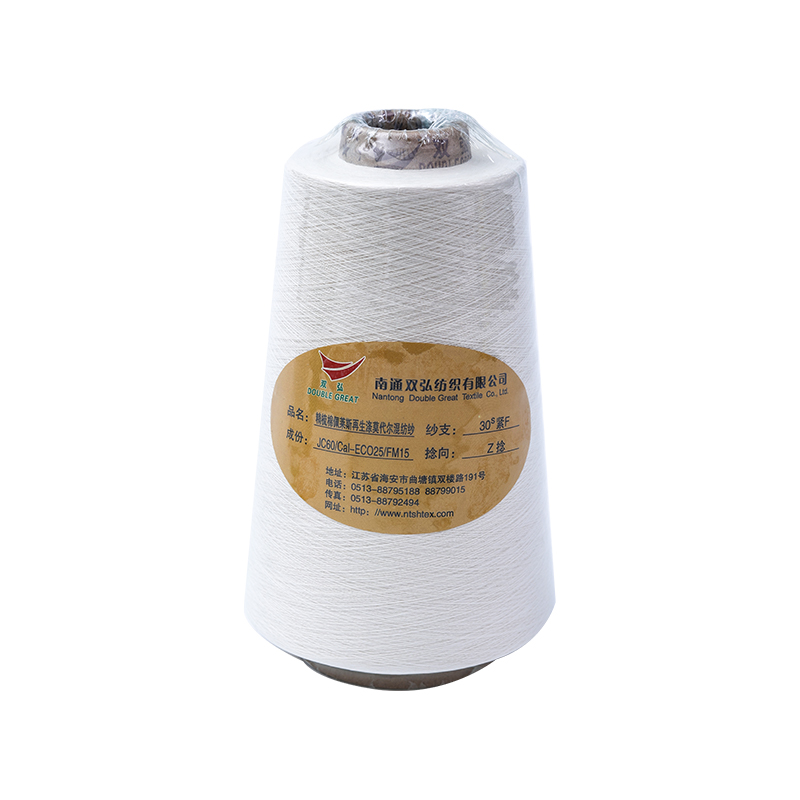
Polyester Blended Yarn Series Polyester Combed Cotton Yarn Combed cotton blended with polyester for apparel that needs cotton's comfort plus polyester's strength, shape retention, and easy care — spun with tight ratio control for uniform, repeatable fabric performance.Heat-Aware Yarn Options for Thermal Comfort Products
Many teams asking about microwaves are actually building warmth products — and for those, fiber innovation offers options that never enter a microwave at all. If the goal is a product that feels warm, keeps the wearer comfortable, and survives repeated washing, functional yarns deliver warmth through physics rather than through a heating cycle.
Far-infrared yarn absorbs the body's own radiant heat and moisture and re-emits energy in the far-infrared band, producing a gentle, sustained warming sensation with no external power source. It is specified for thermal underwear, blankets, recovery wear, and gloves — products whose warming effect must survive laundering, not a trip to the kitchen. For a heated-comfort brand, it converts a "warm feeling" claim into a verifiable material property.
Functional Guard Yarn Series Far-Infrared Yarn Absorbs body heat and re-emits far-infrared energy for sustained wearable warmth — engineered for thermal underwear, blankets, gloves, and recovery wear that must keep its warming effect after washing.Graphene yarn takes a similar route from a different direction: a graphene layer on the fiber improves thermal conductivity and spreads warmth more evenly across the fabric, while adding natural antibacterial performance that suits base layers and socks. And for makers of microwave heating bags themselves, the core yarn specification remains refreshingly simple: a high-quality 100% combed cotton yarn — clean, strong, low-hairiness — paired with matching cotton sewing thread. That combination gives the soft hand the category demands and the predictable, melt-free heat behavior the category requires.
How a Specialized Mill Verifies Heat-Related Yarn Performance
A specification is only as good as the evidence behind it. Heat-related failures usually trace back to three measurable yarn properties: fiber composition accuracy, moisture behavior, and the thermal tolerance of any finishes on the fiber. A mill equipped to control and document those three variables can sign off on a heat-exposed product with confidence, and buyers can tell the difference with a few pointed questions.
- Blend ratio verification. Precise inline blending control ensures a yarn labeled 65/35 measures 65/35 in the lab, not just in the recipe — the foundation of every downstream fabric claim.
- Evenness and imperfection testing. USTER-class instruments track uniformity, thin places, thick places, and neps, which in turn govern seam strength and how predictably a stitched line heats.
- Moisture testing. Oven-dry and conditioned regain measurements predict microwave behavior before a single prototype bag is sewn.
- Flammability data. Limiting oxygen index and vertical burn results give flame-retardant specifications a number a brand can stand behind.
- Accredited laboratory work. Testing inside a CNAS-accredited central laboratory, under a USTERIZED quality system, gives results independent-grade traceability — which is why our own lab also serves as a yarn testing center for the China Cotton Textile Industry Association.
Buyers do not need a laboratory of their own to use any of this — they need to ask for the reports. A mill that produces composition, evenness, and thermal data without hesitation is a mill whose specifications hold up in the field, in the wash, and in the microwave debate.
A Buyer's Checklist for Any Yarn That Will Meet Heat
Before committing a yarn to any product that encounters elevated temperature — microwave, iron, dryer, or open flame — run the sourcing decision through this checklist:
- Define the heat source and its realistic maximum: microwave heating, body heat, pressing, tumble drying, or flame exposure each demand different fiber behavior.
- Specify 100% natural fiber — with matching natural sewing thread — for any item that goes inside a microwave, and write the exception out explicitly in the spec sheet.
- Request a fiber composition report, not just a label claim, so the polyester percentage is a measured number.
- Ask for moisture regain data when heating behavior matters; it predicts hot-spot risk better than any hand feel assessment.
- For flame-retardant requirements, request limiting oxygen index values and the test method used, not just the words "flame retardant."
- Check dry-heat shrinkage tolerance, because a yarn that moves under heat will move in the finished garment too.
- Confirm the testing laboratory's accreditation so the numbers on the report carry weight with your own quality team.
- Match the sewing thread to the shell yarn — a cotton shell stitched with synthetic thread fails at the seam first, every time.
- Run a pilot heating cycle on finished samples: ten heating-and-cooling rounds, then inspect seams, color, and hand feel.
- Print conservative care instructions, including maximum heating time, and keep them consistent with the yarn specification.
Frequently Asked Questions
Is 100% cotton yarn automatically safe in the microwave?
Cotton is the correct fiber choice, but it is not a license to overheat. Cotton holds moisture, heats gently, and chars rather than melts, yet a dry cotton bag run for too long can scorch, brown, and eventually ignite. Heat in short intervals, keep natural fillings dry but not bone-dry, stir or redistribute the filling between cycles, and never leave a heating bag unattended in the microwave.
What thread should I use to stitch a microwave heating bag?
100% cotton thread, always. Seams concentrate heat because stitched yarn holds little free moisture and insulates itself from the filling. A polyester or blended thread fails in that seam first — stiffening, shrinking, and weakening exactly where the bag carries hot filling — so the thread specification matters even more than the shell fabric.
Does a low polyester percentage, like 10%, make the blend microwave safe?
No. Hot spots do not respect percentages. Even a cotton-rich 90/10 blend places a softening, shrinking fiber inside the densest, fastest-heating part of the product — the seam. For microwave items the specification should read 100% cotton with no exceptions; blend ratios belong in apparel, where they deliver real value.
What fillings work best inside microwave heating bags?
Proven fillings include rice, flaxseed, wheat berries, and dried cherry pits, optionally blended with dried lavender or other herbs for scent. All of them are natural, moisture-bearing, and food-safe. Avoid synthetic beads and foams entirely, and advise users to keep fillings dry — damp filling molds, while bone-dry filling scorches — and to replace filling that has degraded.
Can I use a cotton polyester blend for a removable outer cover?
Technically yes, if the cover is always removed before heating, but we advise against it. Removable covers get forgotten, and a single accidental microwave cycle with a blended cover inside is enough to stiffen seams and raise a liability question. A 100% cotton cover removes the failure mode altogether at almost no cost difference.
Is wool yarn a good alternative for microwaveable products?
Wool can work: like cotton, it chars rather than melts, and some heated products use wool successfully. The trade-offs are cost, potential odor when damp wool is heated, and care complexity. For most heating bags, compresses, and plush products, 100% cotton remains the simplest, most predictable, and most economical safe specification.
How can I tell whether an unlabeled yarn is actually a blend?
A careful burn test on a small swatch tells you quickly. Natural cellulose fibers smell like burning paper and leave soft gray ash; polyester shrinks from the flame, melts into a hard dark bead, and gives a chemical smell. A hard glossy bead means synthetic content. For anything commercial, the definitive method is a fiber composition report from the supplier's laboratory — ask for it before the first kilogram ships.
Every heated textile product starts with a single yarn decision, and it is far cheaper to get that decision right at the sourcing stage than to discover it in a customer's kitchen. Whether a project needs 100% combed cotton for microwave-safe heating bags, a precision 65/35 blend for uniform programs, or functional far-infrared and flame-retardant yarns for warmth and safety lines, the conversation should start with actual spinning capability and laboratory evidence — not marketing claims.
Talk to a Mill That Spins Both
Nantong Double Great Textile has spent more than four decades focused on high-quality, differentiated yarn — from polyester-combed cotton blends to functional guard series — backed by a CNAS-accredited central laboratory, USTER testing equipment, and USTERIZED quality certification. For blend ratio specifications, heat-related yarn questions, or custom counts and functional requirements, contact our yarn specialists and get a recommendation grounded in lab data and four decades of spinning experience.