 English
 русский
 Español

Why 65/35 Still Sets the Reference Point for Polyester Cotton Blended Yarn
Ask a spinning mill to quote a polyester cotton blended yarn and the first specification you will usually receive back is 65/35 — sixty-five percent polyester staple fibre, thirty-five percent cotton. That number is not a marketing habit. It is a balance point that has survived four decades of fibre development because it settles three problems at once: it keeps the yarn strong enough for high-speed circular knitting and air-jet weaving, it keeps the fabric comfortable enough to sit against skin for a full shift, and it keeps the cost per kilogram well below a pure cotton yarn of the same count.
Move away from 65/35 and something always gives. Drop polyester to 50 percent and the yarn becomes softer and more absorbent, but single yarn tenacity falls by roughly fifteen to twenty percent and the finished garment starts to crease visibly after a few washes. Push polyester to 80 percent and you gain abrasion resistance and cost efficiency, but moisture regain drops below 1.5 percent, static builds up in dry climates, and the fabric acquires the slightly plastic hand that buyers reject on direct-skin programmes.
| Blend (P/C) | Usual count range (Ne) | Tenacity (cN/tex) | Moisture regain (%) | Where it earns its place |
|---|---|---|---|---|
| 80/20 | 20–40 | 26–30 | 1.2–1.5 | Bag fabric, lining, embroidery base, industrial cloth |
| 65/35 | 20–45 | 22–26 | 1.5–1.9 | Workwear, shirting, pocketing, uniform twill |
| 50/50 | 16–40 | 20–24 | 2.0–2.3 | Bed linen, institutional uniform, sheeting |
| 40/60 CVC | 20–40 | 17–20 | 2.5–2.9 | Jersey, polo, underwear, light knitwear |
| 35/65 cotton rich | 20–40 | 15–18 | 3.0–3.4 | Babywear, towelling, close-to-skin knits |
The 65/35 line is also the easiest commercial argument to defend. Polyester staple trades below cotton on almost every fibre index, so every percentage point shifted from cotton to polyester reduces raw material cost per kilogram. On a Ne 30 ring-spun yarn that gap is not small: a mill quoting 65/35 and a mill quoting 40/60 CVC of identical count and twist are frequently ten to fifteen percent apart on price, and most of that spread is fibre cost rather than labour.
None of this makes 65/35 the correct answer for every programme. A babywear buyer, a towelling buyer or a premium jersey buyer needs the cotton-rich side of the range and should expect to pay for it. The workable approach is to start from the ratio that matches the end use, then write that ratio into the purchase contract with an explicit tolerance — commonly plus or minus two percentage points on cotton content — so that a fibre substitution does not quietly change the hand of the fabric three shipments later.
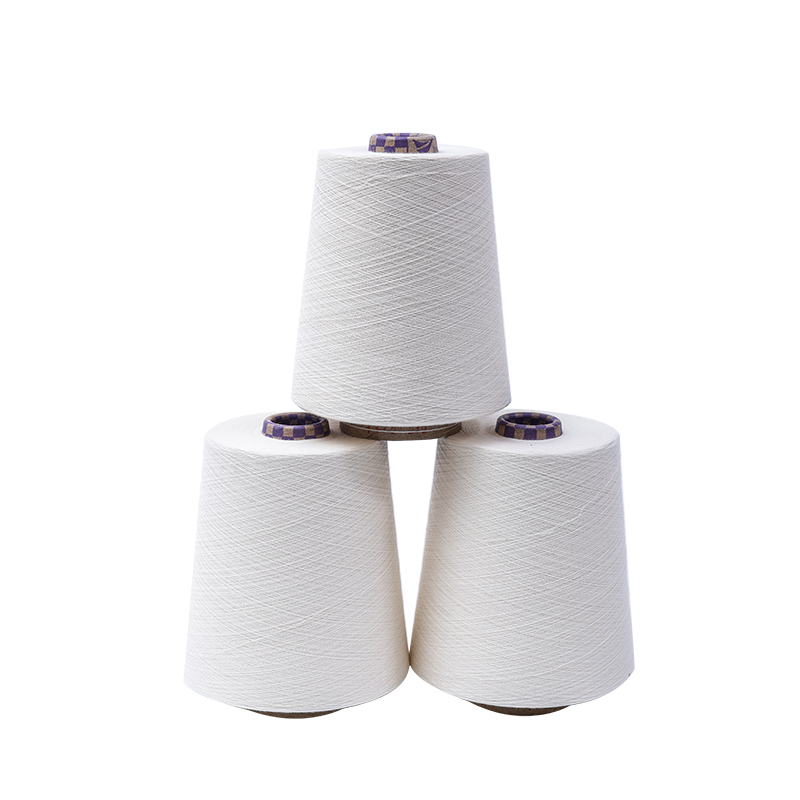
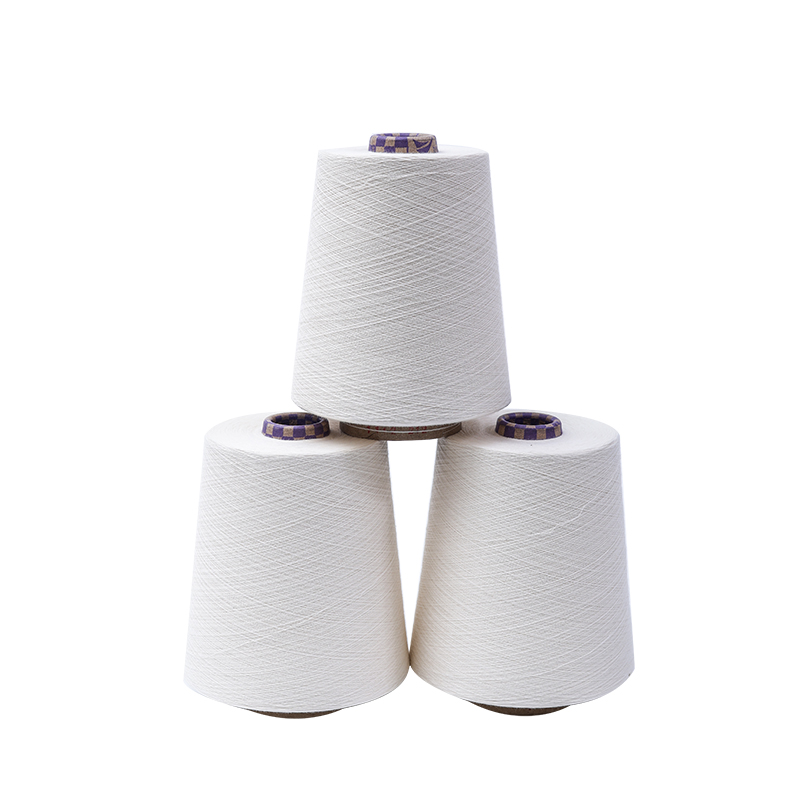 Polyester Combed Cotton Blended Yarn T65/JC35A standard 65/35 polyester-combed cotton blend in counts from 21S to 60S, balancing abrasion resistance with softness for durable everyday shirts, workwear and bedding.View Product →
Fibre Selection Decides the Yarn Before the First Bobbin Turns
Two mills can both supply a 65/35 Ne 30 ring-spun yarn and hand back samples that behave like different products. The difference almost always sits upstream of the spinning frame. Staple length, short fibre content and fibre denier influence tenacity, hairiness and dye uniformity far more than any adjustment made at the ring, and they are the first things a technical buyer should ask about.
The cotton component
Above Ne 30, combed cotton is the practical default for a polyester cotton blend. Combing removes short fibres and neps that would otherwise migrate to the yarn surface and show up as white specks after piece dyeing. For counts between Ne 21 and Ne 30, carded cotton can be perfectly serviceable provided the short fibre content stays under roughly twelve percent and the Micronaire sits in the 3.8 to 4.6 window. Outside that window the cotton becomes either too immature — weak, neppy, difficult to draft evenly — or too coarse, which limits the fineness the blend can reach.
Fibre length uniformity deserves more attention than it usually receives. A cotton lot with a high coefficient of variation in length will draft unevenly against a uniform polyester staple, and the resulting yarn shows periodic thick and thin places that no amount of winding will remove. Buyers specifying a polyester cotton blended yarn for warp use should ask for the length uniformity index alongside the usual Micronaire and strength figures.
The polyester component
On the polyester side, 1.2 dtex and 1.4 dtex bright staple dominate apparel blends. Finer denier gives a softer hand and better coverage per unit weight but increases the risk of neps during carding. Coarser denier — 1.7 dtex and above — spins more cleanly and resists pilling better, which is why it appears in workwear and industrial programmes where appearance retention matters more than touch.
Optical brightener content is a detail that catches buyers out. Polyester carrying a high brightener load reads cooler and bluer under retail lighting, and in a piece-dyed fabric that difference shows as a visible tone shift between the polyester and the cotton. For pale shades and white grounds, specify the brightener level rather than accepting whatever the fibre supplier ships that month.
Inside the Spinning Route: Where a Blended Yarn Usually Goes Wrong
Polyester and cotton behave differently at every stage of the process. Cotton is crimped, relatively weak when drafted alone and prone to nepping. Polyester is smooth, strong and slippery, with a tendency to lap on card cylinders and to generate static in dry air. A spinning line set up for one fibre will not handle the other well, which is why blend quality is largely a question of how carefully the two streams are managed before they meet.
Blow room and carding
Static control and cylinder wire selection matter more than production rate. Running polyester at excessive speed raises nep counts that combing cannot fully recover.
Drawing and blending
Three passages with blend-intimate drawing give a far more uniform colour base than two. Fibre mixing at drawing determines whether the finished yarn dyes level or streaks.
Roving
Higher twist coefficients reduce end breaks on the roving frame, but excess twist creates false draft in the zone and shows up later as irregularity.
Ring spinning
Spindle speed, traveller weight and balloon control all need re-tuning. Polyester-cotton blends run hotter at the traveller, so traveller life shortens noticeably.
Winding and clearing
Electronic clearing limits must be set against the actual fault distribution of the blend, not copied from a pure cotton recipe of the same count.
The drawing stage deserves particular scrutiny. Because the two fibres differ in reflectance and dye affinity, any failure to distribute them evenly at drawing becomes visible after dyeing as a cloudy or melange effect that no dyehouse correction can fix. Mills that spin this blend routinely usually run a blend-intimate drawing sequence and verify the mix with a fibre-content test on the drawn sliver rather than trusting the weighpan alone.
Equipment condition also shows up earlier in a blend than in a single-fibre yarn. Worn top rollers, mis-set aprons and drifting draft ratios produce irregularity that reads as acceptable on the evenness tester but appears as barré in a circular-knitted panel. Buyers visiting a supplier should look at the mill behind these yarns and ask specifically how drawing and spinning settings are validated after a fibre lot changes.
Reading a Test Report on Polyester Cotton Blended Yarn
A test certificate is only useful if the buyer knows which numbers actually predict downstream behaviour. Count variation and evenness affect fabric weight and cost. Tenacity and elongation affect knitting efficiency and end-break rates. Hairiness affects pilling, weaving efficiency and the amount of sizing chemistry needed. Fault counts affect the number of cuts per hundred kilometres and therefore the labour cost of clearing.
| Parameter | Test standard | Typical acceptance window | Downstream consequence |
|---|---|---|---|
| Count deviation | ISO 2060 | ±1.5% | Fabric weight, yarn consumption, costing |
| Count CV% | ISO 2060 | ≤ 2.0% | Weight variation between cones and across a beam |
| Single yarn tenacity | ISO 2062 | ≥ 13 cN/tex | End breaks in knitting, warp stops in weaving |
| Elongation at break | ISO 2062 | 5.5–7.5% | Loop formation, elastic recovery, seam strength |
| Evenness CVm | USTER Tester | ≤ 12.5% | Fabric appearance, barré risk, dye uniformity |
| Thin places −50% | USTER Tester | ≤ 10 per km | Weak points, warp breakage |
| Thick places +50% | USTER Tester | ≤ 35 per km | Slubs in fabric, needle damage |
| Neps +200% | USTER Tester | ≤ 35 per km | Surface defects after dyeing |
| Hairiness H | USTER Tester | 4.5–5.5 | Pilling, sizing pickup, dust generation |
Where a supplier can place results against USTER Statistics, the position on the percentile chart is more informative than the raw figure. A CVm that sits at the 50 percent line is market average for the count; the same value at the 25 percent line indicates a genuinely better-controlled process. Buyers should ask for the percentile statement rather than an isolated number, because an isolated number without a reference population can be presented as strong when it is not.
One number that rarely appears on a standard certificate but matters enormously is shade consistency between lots. For a programme running over several months, a delta E limit between shipments should be written into the specification. In practice a limit of 1.0 or better on a spectrophotometer reading under D65 removes most of the disputes that otherwise arise when a buyer receives the third delivery of a colour that no longer matches the first.
Count, Twist and the Hand Feel Buyers Judge in the Showroom
Hand feel is not a subjective mystery. It is a predictable outcome of count, twist multiplier, hairiness and fibre denier, and it can be specified. A polyester cotton blend spun at a high twist multiplier feels crisp and dry, which suits shirting and pocketing. The same fibre blend spun at a lower multiplier feels softer and drapes more, which suits jersey and light woven tops.
| Count (Ne) | Twist multiplier | Typical fabric | Governing requirement |
|---|---|---|---|
| 20–24 | 3.8–4.2 | Heavy twill, canvas, bag cloth | Abrasion resistance, strength |
| 26–30 | 3.9–4.3 | Workwear, uniform, pocketing | Dimensional stability, colour fastness |
| 30–36 | 4.0–4.4 | Shirting, poplin, sheeting | Evenness, low hairiness |
| 36–45 | 3.6–4.0 | Fine knit, voile, lining | Softness, nep control |
Twist direction interacts with the fabric structure more than most buyers expect. A Z-twist yarn knitted into a single jersey will lean, and the degree of lean depends on the twist multiplier. For panel-critical programmes, specifying the twist direction and multiplier removes a variable that otherwise surfaces only at the cutting stage, when the fabric has already been knitted and finished.
Hairiness is the quiet driver of perceived quality. A yarn with a hairiness index of 5.5 feels fuzzy and pills visibly after ten domestic washes, while the same blend at 4.6 looks cleaner on the shelf and holds its surface longer. Reducing hairiness costs money at the spinning frame through lower spindle speeds and additional winding, so it belongs in the commercial negotiation rather than being treated as a free default.
Dyeing Polyester Cotton Blended Yarn Without Colour Drift
The two fibres in this blend take completely different dye classes. Cotton requires reactive, vat or direct dyes applied in alkaline conditions. Polyester requires disperse dyes, which need either high temperature under pressure or a carrier to penetrate the fibre. That chemical split is the source of nearly every colour problem reported on polyester cotton programmes.
Why the two fibres fight
Disperse dyes migrate within the polyester during finishing and storage, a phenomenon known as thermomigration. Reactive dyes bond covalently to cotton and stay put. The consequence is that a shade which measures perfectly on the day of dyeing can shift two weeks later as disperse dye moves toward the fibre surface. On dark shades the shift is often invisible; on pale greys, beiges and pastels it becomes a customer complaint.
Two-bath versus one-bath two-step
Two-bath dyeing — disperse on polyester first, then reactive on cotton — gives the widest shade window and the best reproducibility, at the cost of an extra rinse and longer cycle time. One-bath two-step processes compress the cycle and cut water consumption, but they narrow the usable shade range and demand tighter control of pH and temperature ramps. For a buyer specifying a colour standard that must hold across multiple production lots, two-bath sequencing is usually the safer commercial choice even where the price per kilogram is slightly higher.
- Tone-on-tone effects are intentional in many programmes and should be stated as such, because an unintentional tone difference reads as a defect.
- Colour fastness to washing and to light should be specified by standard and grade, not by adjective.
- Chlorine and perspiration fastness matter for workwear and for anything sold into humid markets.
- Batch-to-batch delta E tolerance belongs in the contract, together with the illuminant used for assessment.
Yarn dyeing rather than piece dyeing changes the calculus. Package-dyed yarn gives better penetration and more consistent shade across a lot, and it allows a knitter to combine colours in a single fabric without holding dyed greige. The trade-off is cost and lead time, which is why yarn-dyed polyester cotton is usually reserved for stripes, jacquards and programmes where colour precision is the selling point.
What the Yarn Must Survive: Knitting and Weaving Performance
Yarn that tests well in the laboratory can still fail on the machine. The forces involved in high-speed knitting and air-jet weaving are different in character from a tensile test, and a polyester cotton blend responds to them in specific ways.
Circular knitting
Needle and sinker contact abrades the yarn thousands of times per minute. Hairiness and wax content decide whether the machine runs clean for a shift or stops every forty minutes.
Warp knitting
Yarn is fed under constant tension across hundreds of guides. Elongation consistency matters more than peak tenacity, because one stiff end disrupts the whole beam.
Air-jet weaving
High insertion speeds demand clean, low-hairiness yarn with predictable elongation. Frayed tails and protruding fibres cause weft breakage and loom stops.
Shuttle and rapier weaving
More forgiving on hairiness but less tolerant of thick places and slubs, which show immediately in the greige as visible defects.
Sizing is where the blend's lower absorbency creates practical consequences. Polyester cotton yarn takes up size differently from pure cotton, and a recipe developed for cotton will either over-penetrate or sit on the surface. Surface-sized yarn abrades in the heald frame and sheds size dust across the loom, while over-penetrated yarn becomes stiff and loses the elongation needed for air-jet insertion. Weavers running this blend regularly should expect the sizing recipe to be developed for the blend specifically, not inherited from a cotton line.
Wax content is the other recurring issue in knitting. Polyester takes wax less evenly than cotton, and an uneven wax film produces tension variation between feeders that appears as barre in the finished panel. Mills that supply this blend for circular knitting usually control wax pickup within a narrow band and state the value on the cone ticket, which allows the knitter to adjust feeder tension before the first roll is produced.
Applications Where a Polyester Cotton Blend Outperforms
The blend's commercial strength is that it sits between two extremes. It is more durable than pure cotton at the same count and considerably cheaper, and it is more comfortable and more dyeable than pure polyester. That middle position explains why it dominates workwear, uniform programmes and institutional textiles, and why it keeps a firm foothold in shirting and casual wovens.
| End use | Usual count (Ne) | Blend | What the buyer should specify |
|---|---|---|---|
| Industrial workwear | 20–30 | 65/35 | Tenacity, tear strength, wash fastness, shrinkage |
| Corporate uniform | 26–36 | 65/35 or 50/50 | Colour consistency, crease recovery, pilling grade |
| Shirting and poplin | 30–40 | 65/35 | Evenness, hairiness, nep count |
| Pocketing and lining | 20–30 | 80/20 | Abrasion resistance, cost per kilogram |
| Bed linen and sheeting | 24–40 | 50/50 | Shrinkage, handle, whiteness retention |
| Casual jersey and polo | 26–36 | 40/60 CVC | Softness, pilling, colour depth |
| Hospitality textiles | 20–30 | 50/50 | Industrial wash durability, chlorine fastness |
Workwear is the segment where the blend earns the clearest premium. A 65/35 Ne 24 twill with reasonable tenacity and a tear strength above the contract threshold will typically outlast an equivalent pure cotton garment through two or three times the number of industrial wash cycles, because polyester resists the mechanical abrasion that breaks cotton fibres down. The commercial argument is straightforward: fewer replacement garments per worker per year.
Shirting tells a different story. Here the value is in evenness, low hairiness and consistent shade rather than abrasion, and the buyer is comparing against a cotton poplin that feels softer. Mills supplying this segment usually push the combing and winding standards harder and accept lower production efficiency to hit the appearance targets. A polyester cotton yarn that is good enough for pocketing is rarely good enough for a retail shirt.
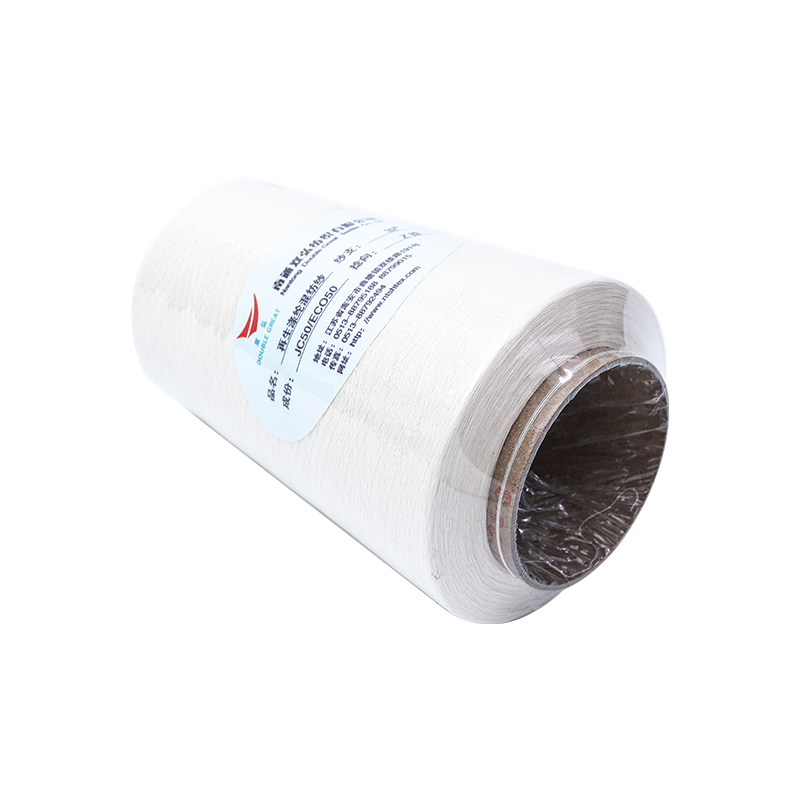 Recycled Polyester Blended Yarn SeriesA recycled polyester blended yarn range with cotton or spandex, offering durable, comfortable options for sportswear, casual wear and home textiles in counts from 16S to 60S.View Product →
Cost Structure: Where the Money Actually Goes
Buyers comparing quotations for the same nominal specification are often surprised by how wide the spread can be. Understanding the cost stack makes it easier to judge whether a lower price reflects genuine efficiency or a hidden downgrade in fibre grade.
- Raw fibre typically represents sixty to seventy-five percent of the delivered cost, which is why blend ratio moves the price so sharply.
- Combing adds measurable cost per kilogram and is worth paying for above Ne 30 or wherever surface cleanliness is a selling point.
- Winding speed and electronic clearing settings trade labour cost against fault levels, and the difference shows up in cut rates rather than on the certificate.
- Package format, cone weight and pallet configuration affect freight and handling, particularly on container shipments.
- Testing and certification add a small but real cost that is often invisible in a quotation until the buyer asks for a full certificate.
The most common source of a suspiciously low quotation is fibre substitution: a lower-grade cotton with a shorter staple, or polyester with a coarser denier, both of which reduce cost without changing the headline blend ratio. The yarn will spin and knit, and it may pass an inspection that only checks count and tenacity. What it will not do is hold the same surface appearance after dyeing or survive the same number of washes.
Payment terms and lead time belong in the same conversation as price. A supplier offering a very competitive rate on ninety-day lead times forces the buyer to carry inventory, and the carrying cost frequently exceeds the price advantage. Comparing landed cost over a twelve-month programme is a more realistic exercise than comparing unit price on a single purchase order.
A Sourcing Checklist Before You Place a Polyester Cotton Blended Yarn Order
- Confirm the blend ratio and write a tolerance — typically plus or minus two percentage points on cotton content — into the specification.
- Ask for the cotton grade, staple length, Micronaire and short fibre content rather than accepting a generic description.
- Ask for the polyester denier, lustre and optical brightener level, especially for pale and white shades.
- Request USTER percentile positions for CVm, thin places, thick places, neps and hairiness, not raw values alone.
- Confirm the spinning system — ring, compact or rotor — because it changes hairiness, strength and the achievable count range.
- Ask whether combing is included and, if so, at what noil extraction rate.
- Verify the twist multiplier and direction against your fabric structure, particularly for single jersey.
- Request a delta E tolerance between lots together with the illuminant used for assessment.
- Ask for a sample cone from the actual production lot, not a laboratory sample, and knit or weave it before approving.
- Confirm package weight, cone taper, pallet format and the documentation that will accompany each shipment.
Two items on that list cause more disputes than the rest combined: blend ratio tolerance and lot-to-lot shade. Both are easy to specify at the outset and extremely difficult to resolve once goods are in a warehouse on the other side of an ocean.
How Polyester Cotton Blended Yarn Compares With the Alternatives
No yarn is universally better. The question is always which compromise a given programme can live with, and buyers who understand the trade-off make faster and more defensible sourcing decisions.
| Yarn | Comfort | Durability | Dyeing complexity | Relative cost | Best fit |
|---|---|---|---|---|---|
| 65/35 polyester cotton | Good | Very good | Moderate | Low to moderate | Workwear, shirting, uniform |
| 100% combed cotton | Excellent | Moderate | Low | High | Premium knitwear, babywear |
| 100% polyester | Poor to fair | Excellent | Low | Low | Industrial, lining, bag cloth |
| Polyester viscose | Very good | Good | Moderate | Moderate | Drapey wovens, suiting |
| Cotton rich CVC | Very good | Good | Moderate | Moderate to high | Jersey, polo, underwear |
Against pure cotton, the blend wins on strength, abrasion resistance, shape retention and cost, and loses on moisture management, initial softness and biodegradability. Against pure polyester, it wins on comfort, dyeability and hand, and loses on ultimate strength and dimensional stability under heat. Against polyester viscose, the contest is closer: the viscose version drapes better and feels cooler, while the cotton version holds up better to repeated industrial laundering.
The 65/35 ratio itself has been examined closely elsewhere, including in this analysis of why the ratio endures. The short version is that it is the point where the cost curve, the strength curve and the comfort curve intersect closely enough that no single stakeholder in a garment programme objects strongly.
Frequently Asked Questions About Polyester Cotton Blended Yarn
Is 65/35 the same as TC yarn?
In most trade usage, yes. TC or T/C refers to a polyester-dominant blend, and 65/35 is the most common commercial expression of it. CVC, by contrast, describes a cotton-dominant blend where cotton usually exceeds fifty percent. The terminology is not perfectly standardised across markets, so the ratio should always be stated numerically in a contract rather than relying on the abbreviation alone.
Can polyester cotton blended yarn be knitted on a machine set up for cotton?
It can, but the settings should change. Tension, feeder configuration and wax application all need review because the blend generates more static and takes wax less evenly. Knitters who run the blend without adjustment typically report barre and needle-line defects within the first few rolls.
Why does the colour look different on the polyester and the cotton after dyeing?
The two fibres accept different dye classes. Reactive dyes bond to cotton, disperse dyes penetrate polyester, and the two never produce identical reflectance under all lighting. Tone-on-tone effects are normal; visible mismatch usually points to a problem in dye selection, carrier control or thermomigration during finishing.
What count range is realistic for this blend?
Commercially, Ne 16 to Ne 45 covers the vast majority of demand. Below Ne 16 the yarn becomes heavy and is usually replaced by coarser structures. Above Ne 45 the cotton component begins to limit evenness and the economics weaken considerably against finer alternative blends.
How does the blend behave in industrial laundering?
Better than pure cotton in most cases. Polyester resists the mechanical abrasion that breaks cotton fibres, so a 65/35 garment typically survives more wash cycles before visible wear. Shrinkage is also lower, which matters for hospitality and healthcare programmes where dimensional consistency is contractual.
Does the yarn pill?
Pilling depends on hairiness, fibre denier and twist. A well-combed, higher-twist yarn with a hairiness index under 5.0 will generally reach a pilling grade of 3.5 to 4 on the standard scale. Lower twist and coarse polyester denier push the result down, and no finishing treatment fully compensates.
Can recycled polyester be used in the blend?
Yes, and it is increasingly requested. Recycled polyester staple can match virgin fibre on denier and tenacity, though colour consistency and brightener level need closer control because feedstock varies. Buyers should ask for the recycled content percentage and the supporting documentation rather than accepting a general claim.
What is the difference between ring-spun and rotor-spun versions?
Ring spinning produces a smoother, stronger, more uniform yarn with better elongation, and it dominates higher-quality apparel. Rotor spinning is faster and cheaper but yields a hairier yarn with lower tenacity, which suits coarser counts and applications where surface appearance is secondary.
How should the yarn be stored before use?
Keep packages sealed, dry and out of direct sunlight. Polyester cotton yarn absorbs moisture readily and can develop package staining if exposed to damp conditions, while prolonged UV exposure degrades the polyester component. A dry store at moderate temperature with pallets off the floor is sufficient for normal production cycles.
What lead time should a buyer expect?
For standard counts held in stock, dispatch is usually measured in days. For custom blend ratios, special colours or counts outside the routine range, planning should allow several weeks from confirmed specification to shipment, plus transit time. Building that into the programme calendar at the outset avoids the common mistake of compressing production time to recover a late approval.
Working With a Mill That Spins This Blend Every Day
The difference between a workable polyester cotton blended yarn and a difficult one is rarely visible on a specification sheet. It shows up in how quickly a mill can trace a shade complaint back to a fibre lot, how consistently the drawing process distributes the two fibres, and whether the winding and clearing settings were developed for the blend or inherited from a cotton line.
A mill that has run this blend for decades accumulates exactly that kind of operating knowledge. Fibre combinations are tested against each other before they reach a customer, and the resulting data sits behind the certificate that accompanies each shipment. That is the practical value of a long production history in a narrow product family: fewer surprises at the knitting machine, and a shorter path from a colour question to an answer.
Whether the requirement is a standard 65/35 workwear yarn, a cotton-rich knitwear blend or a recycled polyester variant, the starting point is the same conversation about end use, count, twist and tolerance. Bring the fabric specification rather than the yarn specification where possible, and the technical route to a workable yarn becomes much shorter.