 English
 русский
 Español
A uniform-program buyer told us recently why her company moved its shirt fabric from 100% cotton to a 65/35 polyester-cotton blend: the cotton version lost 5% in length after its first commercial wash, the collars never sat flat again, and fabric costs rose twice in a single season. The blend held its size within about 1.5%, pressed smooth in seconds, and cost less per finished garment. Her only complaint was that the fabric did not feel quite like the cotton her team was used to.
That single trade-off is the real answer to the question in this title. A polyester blend is better than cotton when a product must survive frequent washing without shrinking, wrinkling, or wearing out, and when cost needs to stay predictable across seasons. Cotton is better when breathability in hot weather, a natural hand feel, and a natural-fiber story matter more than easy care. Neither fiber wins everywhere, and after more than four decades of spinning both, we can say the deciding factor is almost never the fiber itself. It is how the yarn is engineered around the product.
The Short Answer: Is a Polyester Blend Better Than Cotton?
Here is the conclusion first. For wash-heavy products such as shirts, uniforms, bed sheets, polos, sweatshirts, and workwear, a well-engineered polyester blend outperforms 100% cotton on the four metrics that generate the most customer complaints: shrinkage, wrinkling, color fading, and wear-out. For products positioned on natural comfort, including hot-weather basics, premium next-to-skin knitwear, and towels, 100% cotton still earns its place. The two checklists below turn that conclusion into something you can apply directly to your own product line.
Polyester absorbs almost nothing: its moisture regain is about 0.4%. Cotton absorbs 7% to 8.5%. Nearly every comfort, care, and durability difference discussed in this article traces back to that gap, and to the way the two fibers respond to heat.
Choose a polyester blend when
- The garment must survive 30 to 100 wash cycles without shrinking, twisting, or losing shape.
- Wrinkle recovery matters: uniforms, travel clothing, and bed sheets.
- Fabric cost has to stay stable from one season to the next.
- Fast drying and low-effort care are part of the product promise.
Choose 100% cotton when
- Maximum breathability in hot, humid conditions is the priority.
- The product story depends on a natural-fiber claim.
- Softness that improves with every wash is the selling point.
- A matte surface and simple single-fiber dyeing matter to the design.
Because polyester is a thermoplastic fiber with high tenacity, it gives a fabric memory and strength: it recovers from wrinkles, resists stretching, and dries quickly. Because cotton absorbs moisture, it gives a fabric breathability and the softening-with-wash hand feel that customers describe as comfortable. A blend is not a compromise between two bad options. It is a deliberate engineering decision about which properties the product needs most, and the rest of this article explains how to make that decision with real numbers instead of habit.
What a Polyester Blend Actually Is on a Spec Sheet
Before comparing performance, it helps to be precise about the words. A polyester blend is a yarn spun from a measured mixture of polyester staple fibers and another fiber, most often cotton, but also viscose, modal, lyocell, wool, or acrylic. All the blends discussed here use staple fibers, which are short lengths spun into yarn, not the continuous filaments used in sportswear knits. The ratio on the label, such as 65/35, is a real specification: it describes the proportion of each fiber in the yarn, and it can and should be verified at delivery.
Blending happens before spinning, not after
In a properly run spinning mill, the fibers are opened, mixed, and blended at the start of the line, then drawn through several drafting passages so that every meter of finished yarn carries close to the target ratio. Mills that control their process hold the blending ratio to a tolerance of roughly 1.5 to 2 percentage points. This detail matters more than buyers expect. A lot that drifts from 65/35 to 60/40 will take dye differently, feel different in the hand, and behave differently in the wash, even though the label says exactly the same thing.
The language of ratios
- T/C 65/35: polyester-dominant. The classic workwear, uniform, and sheeting blend.
- CVC 60/40 or 70/30: cotton-dominant, short for "chief value cotton." Retail tees and polos that must still hold their shape.
- 50/50: the balanced default for sweatshirts, fleece, and everyday basics.
- 80/20 and 90/10: cotton programs that need a hidden dose of strength and dimensional stability.
- Polyester-viscose, polyester-wool, and other pairings: chosen for drape, warmth, or hand rather than for washing durability.
The most requested ratio in our order book is T/C 65/35, and for good reason: it sits at the point where durability, comfort, and cost intersect for most washing-intensive products. We explain the reasoning in detail in our article on why T/C 65/35 remains the golden ratio, but the short version is simple. The 35% cotton keeps the fabric comfortable against the skin, while the 65% polyester carries the structural load through years of laundering.
Cotton vs Polyester Blend: Head-to-Head on the Properties That Matter
The table below compresses what our laboratory sees when the three options are tested at comparable yarn counts and fabric weights. Treat the values as typical ranges for ring-spun yarns in regularly washed products. Finishing, knitting construction, and twist will shift individual numbers, but the relative order rarely changes.
| Property | 100% cotton | Poly-cotton 65/35 | 100% polyester |
|---|---|---|---|
| Moisture regain | 7% to 8.5% | About 3.2% | 0.2% to 0.4% |
| Comfort in heat | Excellent | Very good | Fair |
| Shrinkage, unfinished knit | 3% to 7% | 1% to 2% | Under 1% |
| Wrinkle recovery | Poor to fair | Good | Excellent |
| Drying speed | Slow | Moderate | Fast |
| Pilling with quality yarn | Moderate; pills wear off | Controllable with good spinning | Low, but pills cling |
| Wash colorfastness | Good | Very good | Excellent |
| Static buildup | Low | Moderate in dry air | High |
| Price behavior across seasons | Seasonal, harvest-driven | More stable | Most stable, oil-linked |
Read the middle column against the other two and the pattern is clear. The blend sits close to polyester on stability, drying speed, and care, and closer to cotton on moisture absorption and wearing comfort. That middle position is exactly why blends dominate categories where garments are washed constantly, and why 100% cotton remains the choice in categories where those stability properties are not the point.
The Numbers That Decide Orders
Three families of numbers decide most sourcing arguments in this category: how much moisture the yarn absorbs, how much a finished fabric shrinks, and how the surface survives repeated washing. The two charts below show the ranges we design against when a customer asks us to hit a shrinkage or comfort specification.
These numbers map directly onto the specifications that appear in most garment programs. Knitwear buyers commonly cap length shrinkage at 5%, and many woven programs at 3%. An unfinished cotton knit starts above those limits and depends on compaction or resin finishing to pass; a 65/35 blend starts inside them naturally. That difference is not a small technicality. It is the difference between a garment that still passes inspection on its twentieth wash and one that quietly generates returns.
Blend Ratios Explained: Where Each Ratio Wins
Ratio selection is where the "better" question gets answered in practice. Each common ratio moves the balance point between the comfort of cotton and the stability of polyester, so the smartest question is not which fiber wins but which ratio matches your washing spec, climate, and price target.
T/C 65/35: the workhorse ratio
This is the ratio behind poplin shirts woven from 45s yarn, institutional sheeting, school and corporate uniforms, and most industrial-laundry programs. The 35% cotton content keeps the fabric from feeling like plastic against the skin, while the polyester majority delivers tear strength at collars and elbows, wrinkle recovery that removes most pressing cost, and quick drying. Many commercial-laundry specifications are literally written around this ratio, expecting 50 to 100 wash cycles at 60°C to 75°C.
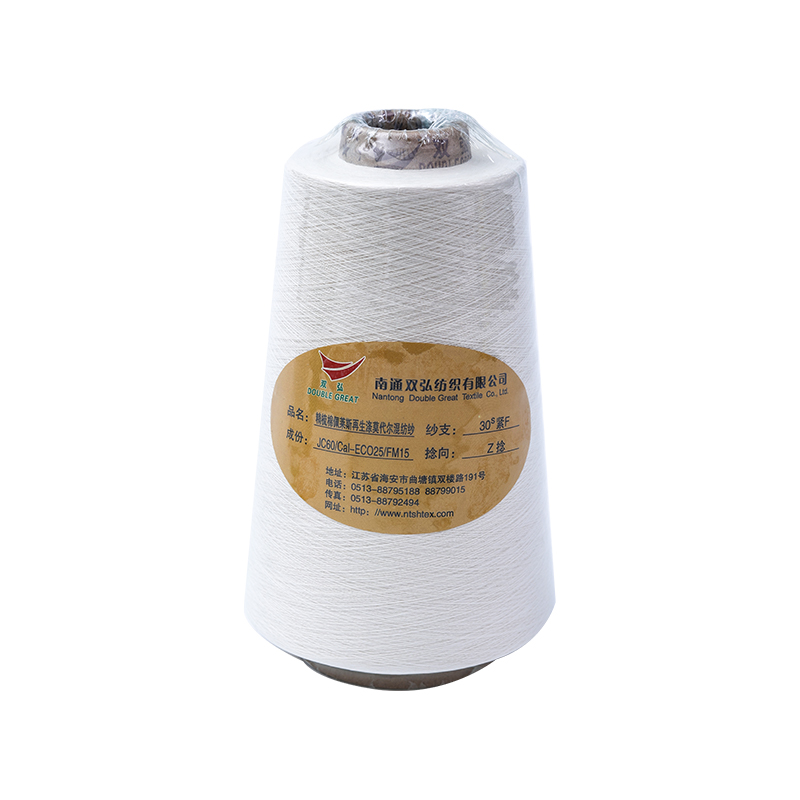
RECOMMENDED YARN Polyester Combed Cotton Yarn (T/C) Combed cotton blended with polyester for low hairiness, higher tenacity, and shade consistency from lot to lot. The yarn behind stable poplin shirting, uniform, and sheeting programs that are washed constantly. View yarn specificationsCVC 60/40: cotton feel with a safety net
In a cotton-dominant CVC blend, the moisture uptake climbs back toward 4% and the hand remains recognizably cotton, which is why retail tee and polo programs favor it. The polyester minority still roughly halves the shrinkage of an equivalent 100% cotton knit and slows the abrasion that thins collars and cuffs. It is the ratio to choose when customers buy for comfort but complain about shape loss.
50/50: the balanced default
Equal parts cotton and polyester is the standard for sweatshirts, fleece, and tote bags. Each fiber contributes equally, so shrinkage and comfort land in the middle, and the cost is the lowest among common cotton blends because polyester is generally cheaper than cotton. The two fibers also take dye differently, which is what makes heather colors possible in single-knit fabrics.
80/20: cotton with a hidden skeleton
Premium programs that want a natural hand and a "cotton-rich" label often specify 80/20. At that level most people cannot tell the difference from 100% cotton in a blind touch test, yet the 20% polyester adds measurable tensile strength, reduces collar deformation, and holds the garment's dimensions through the wash. The same logic appears in core-spun constructions, where a polyester filament core is wrapped in cotton to hide the synthetic fiber entirely while keeping its strength. Our core yarn series runs these constructions daily.
Beyond cotton: polyester-viscose and other partners
Cotton is the most common blend partner, but not the only one. Polyester-viscose yarns trade cotton's crispness for viscose's fluid drape and higher moisture uptake, around 11% to 13% regain, which suits soft flowing knits, dresses, and linings. Polyester-wool brings dimensional stability to suitings that pure wool cannot hold on its own. The logic never changes: polyester contributes strength, recovery, and stability, while the partner fiber contributes the sensory character the product needs.
RECOMMENDED YARN Polyester Viscose Yarn Polyester's strength and stability combined with viscose's fluid drape and moisture uptake. Suited to soft, flowing knits and wovens where comfort and shape retention must coexist. View yarn specificationsWhere Blends Win in Real Products
Ratios are easier to choose when they are attached to real products. These four scenarios cover most of the requests that reach our spinning team.
Uniform and workwear shirts
T/C 65/35 is the default for programs washed in commercial laundries at 60°C to 75°C, often 50 to 100 times over the life of the garment. The polyester component carries tear strength at collars and elbows and lets shirts come out of the dryer ready to wear, which removes most of the pressing cost from the laundry contract.
Bed sheets and bedding
Easy-care percale and polycotton sheeting rely on low shrinkage to keep fitted sheets fitted after months of hot washing and drying. The polyester content also shortens line-drying and tumble time, which is a genuine cost line in hotel and hospital laundries.
Everyday tees and polos
CVC 60/40 keeps the hand feel customers expect from cotton while roughly halving shrinkage and holding collar shape through the season. It also accepts screen printing well when the dyer manages the two fiber systems correctly, which is why it remains a staple of retail basics programs.
Sweatshirts and fleece
A 50/50 brushed fleece keeps its shape through winter, resists the baggy elbows that pure cotton develops, and takes the heather colors that are difficult to achieve in single-fiber fabrics. Higher twist and combed inputs keep the brushed surface from pilling into fuzz.
One honest limit belongs here. For heavy-sweat performance wear, a cotton-polyester blend is not the technical answer; engineered 100% polyester with wicking cross-sections still moves moisture better. Blends win on the economics of comfort plus durability, not on sweat management, and pretending otherwise is how programs end up disappointing their wearers.
Quality Details That Decide Whether the Blend Works
Here is the part most comparisons miss. The same 65/35 ratio can produce a yarn that pills within ten washes or a yarn that stays smooth past fifty. The ratio is a label; the yarn quality is the product. This is where a spinning mill either earns its keep or cuts corners.
Pilling is a yarn-quality problem before it is a blend problem
Pilling happens when short fibers work loose from the yarn surface and tangle into balls. Cotton pills tend to wear away with continued washing; polyester is so strong that it anchors the pill in place, which is why a badly made blend can look worse than either fiber alone. The fixes all live in the spinning plan: long-staple cotton, combing that removes roughly 12% to 18% of the short-fiber noil, adequate twist, and clean, even blending. With those controls in place, a poly-cotton knit can reach grade 4 on the ISO 12945-2 pilling scale, the level most brands consider acceptable for everyday wear.
Ask for the lab data, not just the ratio
Evenness, imperfections, and hairiness decide how a yarn dyes, feels, and wears. We test every production batch on USTER instruments in our CNAS-accredited laboratory, and we encourage customers to ask any supplier, including us, for USTER statistics, IPI values, and hairiness readings alongside the ratio declaration. A yarn can be perfectly blended and still be a poor product. The data will tell you which one you are actually buying, before it becomes a shade-variation claim six months later.
Procurement risks worth checking
- Blending-ratio drift between lots, which shows up as a shade change after dyeing. Set a tolerance of about 1.5 percentage points and verify delivered yarn, not just the invoice.
- Substitution of low-grade polyester or short, weak cotton that looks fine in a new sample but roughens visibly after ten washes.
- Contracts with no pilling specification. Add ISO 12945-2 with a target grade, and test on your own fabric construction rather than the yarn alone.
- Two-fiber dyeing done cheaply, which produces two-tone fabric, poor crocking results, or shade change after the first wash.
- Static buildup in dry climates on poly-dominant blends. Cotton-rich ratios or an antistatic finish solve it before wearers complain.
None of these risks are reasons to avoid blends. They are reasons to specify them properly. For a closer look at how blending decisions translate into wear life, our article on how polyester blended yarns enhance durability and comfort in clothing walks through the mechanics in detail.
How to Care for Polyester Blend Garments
Part of the blend's case is that it asks less of the wearer, but easy care is not the same as no care. Polyester softens as temperatures approach 150°C, so heat is the one place blends need genuine respect. A short list covers almost everything:
- Wash everyday garments at 40°C or below. Heavy T/C workwear built for it handles 60°C commercial cycles without distress.
- Tumble dry on low and pull items out promptly. Overdrying at high heat is the fastest way to set wrinkles and dull colors.
- Iron on a medium setting, below 150°C. Cotton-only ironing temperatures can glaze or shine the polyester component.
- Use oxygen-based bleach rather than chlorine. Repeated chlorine exposure weakens fibers and yellows polyester over time.
- Turn garments inside out and close zippers before washing to cut surface abrasion, which is the root cause of pilling.
- Skip long soaks for dark poly-rich colors; the disperse dye component prefers shorter, cooler cycles.
Follow those basics and a 65/35 shirt comes out of a normal home dryer looking pressed, which is precisely the behavior that made blends the default in school uniforms and hotel sheeting decades ago. Cotton demands more attention for a result that blends deliver by construction.
The Sustainability Question: Recycled Polyester Blends
The strongest argument against polyester has never been performance; it is origin. Virgin polyester is made from petroleum. Recycled polyester, produced from post-consumer bottles, changes that equation without changing the performance logic of the blend: strength, dimensional stability, and easy care remain, while the share of virgin polymer drops. For brands that need to support recycled-content claims in finished garments, a recycled blend yarn is the practical entry point.
RECOMMENDED YARN Recycled Polyester Blend Yarn Post-consumer recycled polyester blended with cotton, delivering the stability and easy care of a classic blend with a reduced footprint. Designed for programs that need to back up recycled-content claims. View yarn specificationsTwo honest notes belong next to that product. First, blended fabrics are harder to fiber-recycle at end of life than single-fiber fabrics, because the two polymers must be separated; the practical sustainability play today is recycled inputs combined with long garment life. Second, durability is itself an environmental metric. A shirt that survives a hundred washes replaces the two or three shorter-lived shirts that would otherwise have been bought, so when customers ask whether a blend is better, longevity is part of the answer.
A Practical Way to Decide
Work through the decision in this order and the cotton-versus-blend question usually answers itself:
- Define the washing spec first: how many cycles, at what temperature, commercial or home laundry. This single line decides most of the argument.
- Set the comfort requirement. Hot, humid daily wear pushes toward cotton-rich; structured, wash-heavy programs push toward poly-rich.
- Choose the ratio from the product scenario: 65/35 for uniforms and sheeting, CVC for tees and polos, 50/50 for fleece, 80/20 where the cotton story matters most.
- Specify yarn-level quality: combed cotton, staple length, twist, USTER evenness data, and a pilling grade under ISO 12945-2.
- Run a pilot and wash-test it at five, ten, and twenty cycles; measure shrinkage, skew, and pilling on your own fabric construction.
- Lock the blending-ratio tolerance and shade standards into the contract, then verify lot by lot instead of trusting the label.
If steps one and two point to a wash-heavy program, a blend will beat cotton on every measurable dimension except natural-fiber marketing. If they point to hot-weather comfort or a natural product story, cotton, or a cotton-rich CVC, will serve better than any poly-dominant ratio. The framework removes the guesswork that turns fabric sourcing into an argument between departments.
Frequently Asked Questions
Is a polyester blend better than cotton for hot, humid weather?
Not usually. Cotton's 7% to 8.5% moisture regain lets it absorb and release sweat, which feels cooler in humid heat. For hot-weather basics, choose 100% cotton or a cotton-rich CVC, and save poly-dominant blends for structured garments where stability matters more than evaporative comfort.
Does a poly-cotton blend pill more than pure cotton?
It can, if the yarn is made from short fibers: strong polyester anchors pills that would simply wear away on cotton. With combed cotton, long staple, and proper twist, a blend reaches grade 4 on the ISO 12945-2 scale, equal to or better than an ordinary cotton yarn of the same count.
Which blend ratio feels most like 100% cotton?
Start at 80/20, then CVC 60/40. Above roughly 80% cotton, most people cannot distinguish the fabric from pure cotton in a blind touch test, yet the polyester still adds measurable tear strength and cuts shrinkage noticeably.
Will a 65/35 blend shrink in the wash?
Typically 1% to 2% for an unfinished knit and around 1% for a heat-set woven, against 3% to 7% for unfinished cotton knits. Mechanical finishing narrows both figures further, but the blend starts from a lower base, so it passes tight shrinkage specs with less intervention.
Are polyester blends harder to dye and print?
They require two dye families, disperse for the polyester and reactive for the cotton, so color control is a process question rather than a limitation. When the blending ratio is uniform, both fibers take shade consistently; ratio drift between lots is the usual cause of shade variation, not the blend itself.
Is a blend better value than cotton over the life of the garment?
In most wash-heavy categories, yes. Blends resist the four failure modes that end a garment's useful life early, which are shrinkage, out-of-shape silhouettes, color loss, and thinning fabric. Cost per wear improves because replacements are needed less often, even at a similar purchase price.
Are poly-cotton blends suitable for sensitive skin?
Generally yes, provided the yarn is smooth and well finished. Combed, low-hairiness blends reduce the surface texture that irritates some wearers, and the cotton share keeps moisture next to the skin at a comfortable level. Extremely reactive skin often still prefers 100% cotton, so keep both options in the range.
Every year our team helps garment developers and fabric mills settle this exact question with yarn data instead of generalizations. If you are weighing a specific program, whether a tee, a sheet set, or a uniform run, send us your target ratio, yarn count, and washing requirements, and our spinning team will recommend a yarn and share the evenness, tenacity, and pilling results from our laboratory. You can also explore the polyester blended yarn series on our site to see the ratios and fiber partners we spin every day.