 English
 русский
 Español
Bamboo fiber yarn is a new type of natural fiber yarn that has gained increasing attention in the textile industry due to its eco-friendly properties, antibacterial effect, breathability, and softness. The spinning technology of bamboo fiber yarn differs significantly from traditional cotton and polyester yarns, which determines the quality and performance of the final product.
Raw Material Processing
Bamboo fiber yarn is mainly derived from natural bamboo, extracted through chemical or mechanical methods. The chemical method usually involves alkaline treatment and dissolution to extract cellulose fibers, forming short fibers. The mechanical method relies on physical crushing and fiber separation. Before spinning, bamboo fibers must be cleaned, opened, and carded to ensure smoothness and uniformity. Cotton yarn is made from natural cotton, processed by loosening, carding, and slivering, ready for spinning. Polyester yarn uses synthetic polyester filaments or cut fibers, which are stable and can be directly spun with minimal preprocessing.
Fiber Length and Spinning Adaptability
Bamboo fiber yarn usually contains fibers 1–3 cm in length, with a high proportion of short fibers. This requires precise carding and twisting to reduce yarn breakage and fuzz. Cotton fibers generally range from 2–3 cm in length, with better flexibility and lower breakage rates. Polyester fibers, as filaments or cut fibers, are easier to spin. Filament polyester is spun efficiently with high strength and minimal fuzz, while staple polyester requires carding for uniformity.
Carding and Drawing
Bamboo fiber yarn requires multiple carding and drawing steps to improve fiber uniformity and prevent short fiber loss. During carding, bamboo fibers are prone to static and entanglement, necessitating careful humidity and tension control. Cotton carding is mature, with low breakage. Polyester fibers are easy to card, and static can be reduced using antistatic treatments or lubricants.
Spinning Methods and Equipment
Bamboo fiber yarn is mainly spun using ring spinning or air-jet spinning. Ring spinning produces high-strength and uniform yarn suitable for medium to high-count yarns. Air-jet spinning reduces fuzz and improves yarn surface smoothness. Cotton is spun using ring or long-staple spinning with well-established processes. Polyester filaments are spun directly from filaments, achieving high efficiency and low fuzz. Bamboo fiber spinning requires precise twist control and yarn count adjustment to balance softness and strength, while carefully managing tension.
Yarn Properties and Finishing
Bamboo fiber yarn is soft, smooth, naturally antibacterial, and highly breathable, but slightly weaker than polyester or high-quality cotton yarn. Yarn strength and durability can be improved through post-spinning treatments such as heat setting, twisting, or blending. Cotton yarn finishing focuses on dyeing and shrink resistance, while polyester finishing emphasizes luster and dimensional stability.
Blending Applications
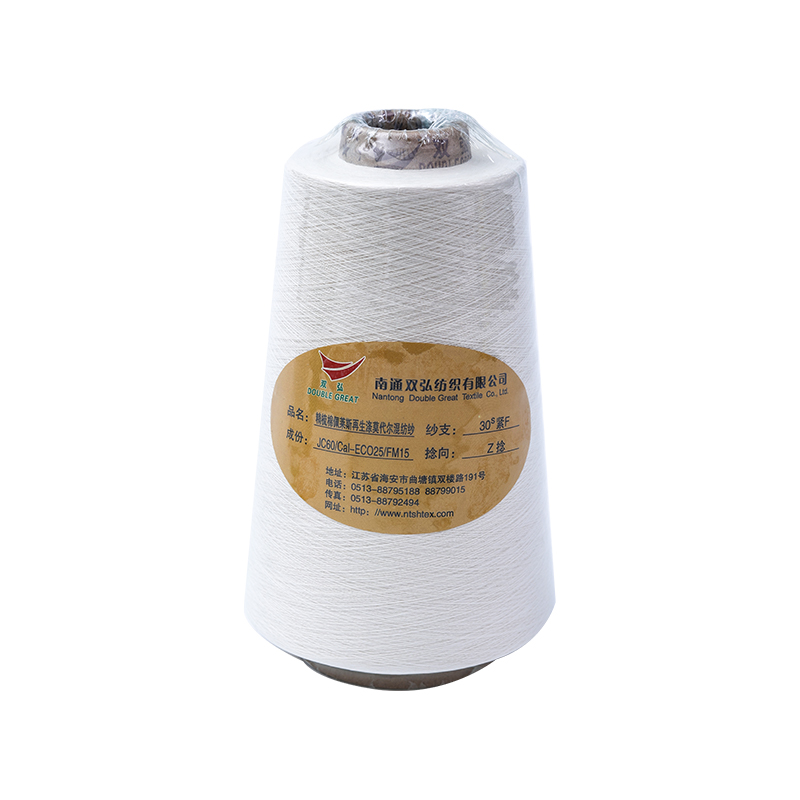
To compensate for lower strength, bamboo fiber yarn is often blended with cotton, polyester, or wool. Blend ratios and spinning processes are carefully controlled to ensure uniformity and mechanical performance while retaining bamboo's natural properties. Cotton blends are widely used with mature processes, and polyester blends are optimized for large-scale production. Bamboo fiber blends emphasize environmental benefits and functional properties.